Thursday, July 19, 2012

chew on this

cheesy treat or satellite photo of the moon?

I fell in with a group of Paraguayans recently, and I have learned that it pays to admit you are hungry when you are around Paraguayans.  I am passing the gains along to you.

Have you ever had a cheese rock?  If you haven't, you may think that sounds like a terrible name for a food, or really more like an ailment you might develop from eating food that was prepared improperly and which might require brief hospitalization.  But if you have had one, chances are you are thinking happy thoughts now that I reminded you of them.  Maybe you have had a chance to go the the Big Booty Bakery (that is really the name) in New York City and snag yourself some.  Maybe you have spent some time in Brazil, where cheese rocks are known to the people there as "pão de queijo."  Of course, the people there do not say "pão de queijo" in a way that might lead you to suspect that they are talking about bread made from cheese and that this is how you spell it.  They say something along the lines of "powmkwangjhou." Whatever flair for languages I have has never extended to Portuguese, and many of my beloveds speak it.  Though it is merely an observation, and not an unfriendly one, the fact that Portuguese always makes me think of the Lorax ("he sounds as if he had smallish bees up his nose") probably can be traced to sour grapes.

But what all this has to do with Paraguay is that a friendly Paraguayan person made me something she called "embayjew," and which turns out to be called "mbeyu" (not far from Paraquay to Brazil, via the Truffula forest.)  I recreated it for my nephew, whose mother--my sister--spent lots of happy time in Brazil and chats away merrily ("jhoojh!  jhoojh! owm owm! jhoojh!) with my aunt and cousins while I sit and listen.  This is like a flat pmkaykji, said the nephew, whose flair for Portuguese is perhaps less keen even than mine.  He is right, though.  It's a crispy, flattened one of them there things he means.

One of the many nice things about pão de queijo and mbeyu is that they are gluten-free, and another nice thing is that they are both chewy and crispy--two qualities that often elude GF bakers and eaters alike--and also cheesy, which is always tasty.  They are simple to make and require only one odd-seeming ingredient, tapioca flour or starch, which in fact is readily available even if you have never had call to look for it.  Both Bob's Red Mill and Ener-G make it and it is generally with all the weird flours in your Gourmet Shoppe or health food emporium, or even a big chain grocery.  Most recipes for pão de queijo seem to call for an egg, which my sisters cannot eat, and these little delights do not require one.  Furthermore, the Paraguayan angel who whipped these up for me used goat cheese, meaning they are suitable for those who eschew cow dairy, too (see above, "sisters of mine.")  I have since made them with all manner of cheeses.  They are pretty flexible in this regard, and no more complicated to produce than a pie crust.

mbeyu

1 cup tapioca flour
pinch of salt
3-4 T cool butter, ghee or vegetable shortening (use the lesser amount if you are using soft cheese as well as hard)
a generous cup of coarsely-grated cheddar-like cheese, or about 3/4 c plus 1/4 cup of fresh soft goat cheese
3-4 T cold milk (goat or cow)

Mix the flour and salt together in a medium bowl, then work the butter or shortening into it as you would to make a pie crust. Add the cheese and toss to combine, then add a bit of milk at a time until the dough just comes together when you pinch it.  It should still look more crumbly than dough-like.

Heat a heavy skillet over medium heat and swirl a bit of butter or ghee or olive oil in it.  Take a handful of dough and flatten it into a disk (this recipe will make you two 6-7" cakes, or you can make little wee ones instead).  Plop in onto the hot pan and flatten it a bit more.  Cook about three minutes, until it is nicely golden, and then flip to repeat for the other side.  Eat nice and hot, maybe alongside some soup or just with a drizzle of hot sauce or other condiment that appeals.

Friday, July 13, 2012

letting the freak flag fly


I am really hesitant to share this particular recipe because I am still living down a single episode from some years ago in which I was persuaded by a magazine article to make guacamole from peas instead of avocados.  Doesn't brown, you know.  To say this experimental maneuver enjoyed limited success would be something of an understatement.  ONE TIME I made this.  Once.  And yet here we are, years later, many decent meals to the good, batches and batches of proper, costly, fleetingly green, traditional and very tasty avocado guacamole down the gullets of those near and dear to me, and still I cannot live down this single rash act with the peas.

Furthermore, I catch a little flak here and there for weird health food things that go on in my kitchen.  Hippie food.  It alienates some people. I try to indulge in these things privately.

So when I was googling around trying to remind myself why chia seeds are good for me (I love them; I just needed to remember why that was such a good thing) and I ran across a recipe for hummus made from edamame and chia seeds, and my curiosity got the better of me, I decided to make it quietly and keep it to myself.  Frankly, the source of the original recipe was a little suspect (not distant enough from the chia pet image problem of these addictive little items, let's say) and I was doubtful of my potential success.  But my family found the stuff, and they ate it, and their friends did too, and they wanted to know how to make some for themselves.  So what I am saying here is, I already know this is hippie food, and weird hippie food at that.  No one needs to tell me that.  But also it can pass.  Even the suspicious seem to snarf it up.

If you are unconvinced of the merits of adding chia seeds to anything, you could make this edamame stuff without them and still be pretty happy, I think.

A note: it sounds like a lot of lemon juice, so much that you may think, as I did, that it is a typo.  While the original recipe was in fact chock full of typos (most of which I sincerely hope are expunged) and some odd choices involving sweet chili sauce (better believe I expunged that right the heck outta there) this bit about the lemon juice was not one of them. I started with a half cup, and by the end, wouldn't you know it but 3/4 of a cup was just about where I finished up.

chia edamame hummus

¾ cup lemon juice
¼ cup water
2 T chia seeds
2 to 3 t kosher salt
2 t ground cumin
1 pound shelled edamame
½ t ground coriander
½ cup tahini
3T extra virgin olive oil
pinch cayenne or dash hot sauce
handful chopped parsley
garlic to taste

In small bowl, mix the chia seeds with lemon juice and water, and set aside to bloom, by which I mean they will soak up quite a bit of liquid.

While this is going on, bring a small pot of water to the boil, salt it a bit and drop in the beans.  Cook 4 to 5 minutes, until bright but tender.  Drain and refresh with a cold water rinse.

In a food processor or blender, pulse the edamame, tahini, water, bloomed chia, garlic,  a portion of the salt, the cumin, coriander, olive oil and parsley until smooth, adding additional water as needed to create a good texture.  Taste and correct the seasoning to your liking.

Wednesday, July 11, 2012

again with the soup!


How much do you know about your TRPV-1 receptors?  Here, I will bring you up to speed if you are as much in the dark about them as I was.  They are the fancy technology in your mouth that alerts your brain when hot food is very hot (as in, thanks to not realizing how hot this coffee was, my tongue will be as functional as a dried sponge for the next 17 hours) or very hot (as in, that must have been the cayenne and not the paprika that I reached for on these eggs.)  Your brain, when it receives the news flash about the weather patterns between your jawbones, gets your sweat glands on the line and flips the 'on' switch.  Hence, why it is not crazy to write about hot soup when it's hotter than a match head outdoors, which it presently  is here in my zip code.  Hot food makes you sweat, and sweating cools you down, see?  NPR explained it to me.  It's probably why fiery cuisines and hot weather go together, they said.

I only just realized that I am already sweating because of it being hot, which kind of bungs a hole in that theory for me.

But this soup was really, really good, which you might not gather from its awful portrait up there.  It comes from Vegetable Soups From Deborah Madison's Kitchen, which I took out of the library. This is my new strategy with cookbooks: kind of like dating before you buy the cow or words to that effect (it's really hot here).  If I become worried the pages are too splotchy to return to the circulation desk in person (hello, nighttime book drop!!), then I know that I have come a really good distance from the library-book phobia I had from the age of 6 (when I lost a book from the Brooklyn Friends lower-school library and had to confess it to the librarian) to the age of however old I was when I got over that, which was a good while after.  Ask me about ice cream cones sometime!  Lost a scoop off of one outside Baskin-Robbins on Montague street as a youngster and I'll leave you to imagine how I handled the "cup or cone?" question until college.

I also know, getting back around to cookbooks, that I am ready to buy the book, now that I have paid half its value in overdue fees.  It's a major cost-cutting trick, this library-dating-of-cookbooks strategy of mine.  I commend it to you.

A couple of the steps here sound weird, but are ultimately stupendously successful.  Love that.  Also it is a tidy little ecosystem of its own, this soup--the trimmings and tailings of the main ingredients are what you use to make the broth.  And it came together quickly, despite there being three sections to the recipe, and everyone liked it. I will attempt to resist the urge to just cook my way through the book and tell you about it, because I think that has been done before, but there are legions of winners in these pages, let me tell you. 

For this one, I have given you all of Ms. Madison's careful measurements of quantity and so forth, but rest assured this was pretty forgiving--I had no leek, no one in my house but me likes peas (I substituted--you guessed it--ZUCCHINI), my parsley levels were unequal to the recipe, and lacking the willingness to blanch almonds, I subbed almond meal which I had a-plenty.  Still tasty.  I think it is the saffron, which I can never resist.

fennel soup with saffron & ricotta dumplings
adapted from Vegetable Soups From Deborah Madison's Kitchen

the stock
the stalks of your fennel bulbs (see below)--about 2 cups
roots and upper sections of a leek or some scallions--about a cup
1 c celery tips and leaves
1 bay leaf
handful of parsley stems
sea salt and fresh pepper

the dumplings
1 pound ricotta cheese
olive oil
a fat pinch of fennel seeds

the soup
1 large or two small fennel bulbs (about a pound)
2-3 tablespoons butter, or a mix of butter and olive oil that appeals to you
2 leeks, white parts only, about a quarter pound, quartered, rinsed, chopped, or equivalent spring onions or scallions
1 celery rib, thinly sliced
2 T chopped parsley
1/3 c almond meal, or 1/2 c blanched almonds, finely ground
2 pinches of saffron threads

to finish: 
about a cup of shelled fresh or thawed frozen peas, or similarly-sized bits of tender young zucchini
finely minced fennel greens or fresh thyme to garnish

Preheat the oven to 350.

Put the vegetable trimmings into a pot with 7 cups of water, the bay leaf and 1/2 teaspoon of salt.  Bring to a boil, reduce the heat, and simmer, covered, for about 25 minutes.

Press the ricotta into a 6-cup baking dish that has been brushed with olive oil, and sprinkle the fennel seeds over the top.  Bake until golden, about 30 minutes.  Set aside to cool and firm. Make the soup while it is baking.

Chop the fennel into pieces that will fit into a soupspoon.  Melt the butter or butter + oil in a soup pot and add the vegetables and parsley.  Season with a teaspoon of salt, toss everything to coat, and cook over medium heat for about 5 minutes.  Add the saffron and almonds and stir well to combine, and then cook, stirring, for a couple of minutes.  Strain the stock--you should have about 6 cups--and admire its color.  Surely J. Crew has a name for this hue.  Add the hot stock to the vegetables, and simmer the combination for about 15 minutes, or until the vegetables are as tender as you would like them to be. Add the peas during the last couple of minutes.  Taste and adjust for salt and pepper.

Cut the ricotta into adorable triangles.  Add a few of them to each bowl and sprinkle with the fresh herbs.  Squeeze of lemon wouldn't hurt, but it helps everything.

Monday, July 9, 2012

summer squashed


I have heard it said that you should lock your car around here in the summer, not to prevent theft but to foil the gardeners who troll parking lots looking for open cars where they can leave their excess zucchini. 

Considering what recently happened to my car, this sounds like a major trade up in terms of larceny. 

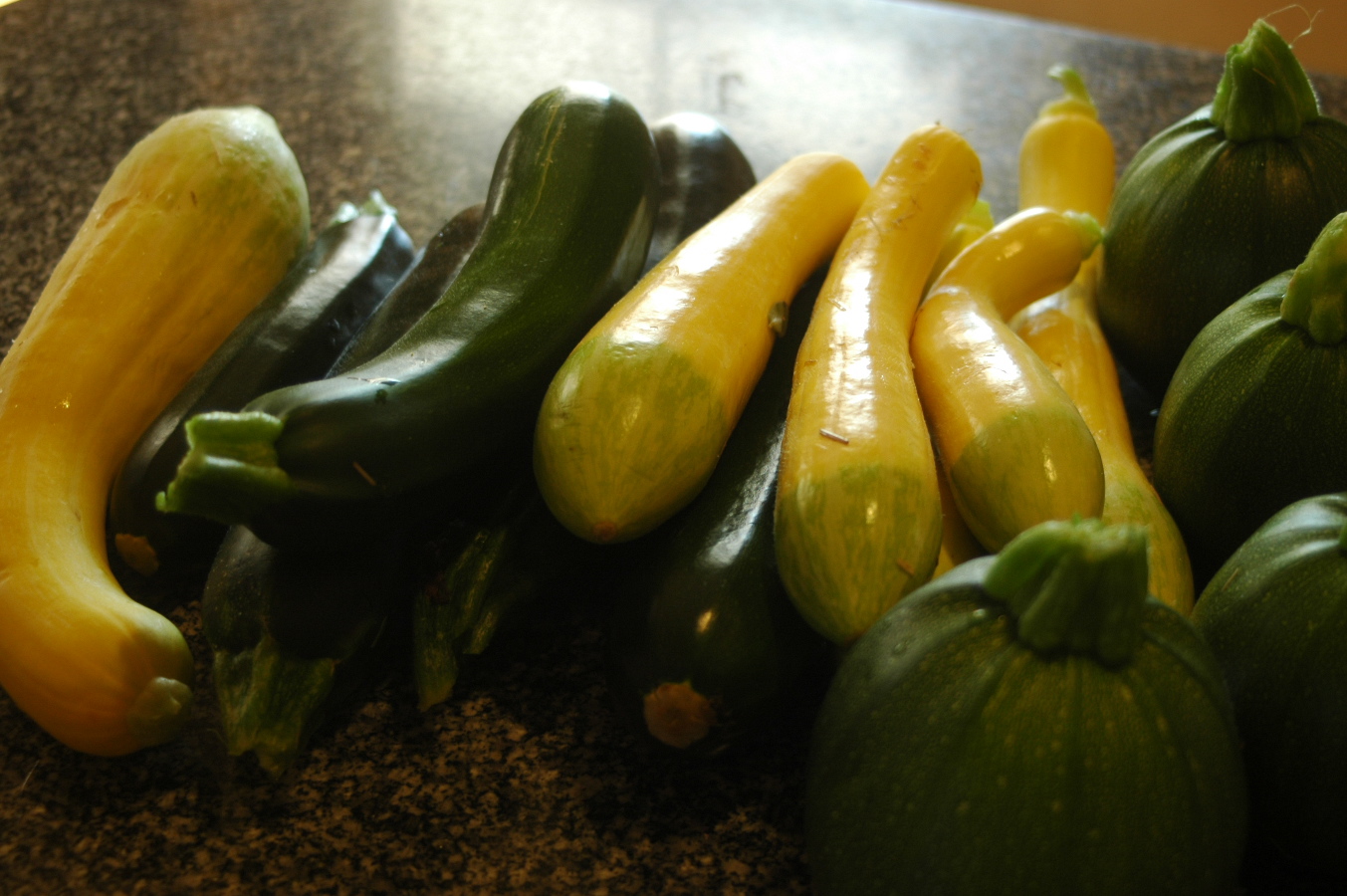
Also, I happen to love zucchini and its yellow cousins. Even now, when the faucets are full-on open, I love them. How can you not love a plant that is so supremely organized and efficient that it can crank out these handsome items 


by the bucketload when all the plants around them are gasping from drought, bolting from heat, withering in the sun? Even when a basket-busting, counter-obscuring, headache-threatening metric buttload of zucchini comes thundering into the house, my ardor remains strong. 

There are a lot of reasons for this ardor, and one them is Julie, who is the undisputed champion of so many areas of the menu that is has become pointless to catalog her numerous titles (Queen of the Bean, Empress of Elixirs, Chile Tsarina). Some broader title needs to be established for her. In one of her characteristically casual moments of generosity, she emailed me about this zucchini soup she had been whipping together. I lacked a few of the things required to reconstruct it exactly, but because I received the email while bushwhacking through a bushel of squash, I punted. 

That was two summers ago, and I've never looked back. With this handy method, it is possible to render a Code Blue Zucchini Situation like this:


into a call for quiet gloating like this:


Magical!  Here is Julie's Zucchini Soup v. 2.0, wherein you, our hero, capitalize on zucchini's confounding ability to sweat large amounts of liquid in the presence of salt, and produce for yourself a substance which can magically transform from summer refresher to winter restorative at the flick of your wrist.  Chill this down right now, and serve it as is--or with a squeeze of lemon on top and maybe a splash of olive or chile oil or a swirl of pesto or a sprinkling of fresh herbs, maybe some buttermilk or this magical yogurt --and you will swagger around feeling pretty spiffy at the end of a hot day.  Maybe you can't bear the idea of another zucchini right now.  Whatever your feelings regarding the zucchini in July, I can attest you will approach it with a twinkle in your eye come February. In the produce doldrums, a warm bowl of this with a swirl of heavy cream and some curry powder is a welcome sight on the placemat.  I freeze as much of this stuff as I can jam into the Kenmore.  Thank you, Julie.

Measurements are profoundly approximate here.  It's more of a method than a recipe.  If your zucchini payload is mostly on the young side (admittedly preferable), no special treatment is required.  If they are a little more aged than that (still well worth using), use your judgement regarding peeling tough outer bits and discarding cottony centers, and try to work a few of the juvenile specimens in with them to ensure that lovely color.


zucchini soup

For every seven or eight zucchini, one medium onion, a decent splash of olive oil and about a quarter cup of white wine (Mirin, or Japanese rice wine, makes a nice alternative), plus salt and pepper and about a teaspoon of lemon zest, very finely grated.

Dice the onion, and heat the olive oil in a large soup pot.  Saute the onion over low heat with about a teaspoon of salt, stirring as necessary, until the onion is soft and not at all brown, about five minutes.

Meanwhile,  hack the squash up by no special method into chunks of 1-2".


Add the squash to the onion along with the wine and lemon and a few twists of pepper, and give it all a good stir.  Turn the heat up, and when the zucchini pieces are nicely coated, add about a cup of water (or broth, if you feel you must, but water is fine).  Bring this to a nice boil, lower the heat to a simmer, and cover the pot.

Cook, stirring every couple minutes to ensure even heating, until the squash has given up a nice amount of liquid and is tender but still bright, like so:


Now attack the pot with your stick blender, and render yourself a nicely even purée.  Fish around determinedly for lurking chunks, and show them no mercy.  A gloriously green and supremely smooth soup is your goal.  You can do this, of course, in batches in a regular blender but take care to recall that hot liquids expand and caution must be exercised.  I tend to burn my eyeballs and make a hell of a mess when I use the regular blender for hot soup.  

Cool and deploy. 

Thursday, July 5, 2012

the next generation


Maybe you remember what I said about chicks raised in the house, and how they grow up to be the chickens with no respect for the boundary of the threshold to the human dwelling. Whenever the wind or a careless human leaves the door unlatched, only the house-raised dare to enter.  You might come to the opening to see a congregation of chickens on the porch, peering in, but they will not cross unless they've logged some time indoors as tots or while receiving in-patient care.  We have one of those chickens in our flock now.  Even the dogs don't notice if she comes inside anymore--I've more than once come into the kitchen to see a sleeping dog on the floor, and Chickalena drinking happily from the water bowl right by his head.  It's a glamorous life for all of us.

OK, so remember the ailing chick and her (I really hope she's a her--still too soon to say) sisterhood of indoor pals?  Great news!  She's still not dead.  And all that house time has really paid off.


In other news, the zucchini are back.  I love it when the zucchini come back, but I think I am the only one beating the drums of welcome.  I love to fry up a huge mess of paper-thin slices with preserved lemon, and I like to make those zucchini-feta pancakes I once told you about, and though I do those things all year long, I especially like doing them generously with fresh, bright, snappy-looking zucchini that taste like something.

When it is too hot to consider standing by the stove flipping pancakes, the same principles that govern those very savory pancakes can be brought to bear on a frittata, which requires no flippage.  A frittata, like an omelette or really any kind of egg, is a very personal matter with probably volumes of written material related to its proper construction.  I feel a little silly pretending to tell anyone how to make one. But the flavors here were nice, and you could personalize this further with, say, some garlic or minced scallions, or red peppers, or that pesky half cup of leftover pasta lurking from last night's dinner.  Frittatas are excellent at any temperature, as you probably know, and are happy to go on picnics.


zucchini-feta frittata with basil & mint

2-3 small (about 7") zucchini, diced
3T olive oil

handful of chopped fresh basil
smaller handful of chopped fresh mint
about 4 oz feta, crumbled

8 eggs
salt & pepper 

handful of cherry tomatoes, quartered (optional, but pretty and very yum)

Heat the oil in a 10" skillet and quickly fry up the zucchini--you are aiming for a still-bright but golden-in-places result.

While this is going on, beat the eggs with the salt and pepper.  How much salt depends on how salty your feta is and how salty you like things. Reserve about a quarter of the feta crumbles, and whisk the rest into the eggs.

Stir the fresh herbs into the zucchini pan.  Now dump in the egg mixture and stir lightly to move the zucchini into the eggs, then resist the urge to stir further or disturb in any way.  Sprinkle the cherry tomatoes on top, and the remaining feta on top of that.  Cook maybe 2 minutes more.Turn off the heat and cover the pan.  

Heat the broiler in your oven.  When it is nice and hot, uncover the pan and slide it under there.  Remain in this spot and totally vigilant for the next 2 minutes while the frittata browns lightly and attractively all over the top, rotating as necessary.  Now turn off the broiler, and let the pan rest there.  After a few minutes, check the firmness of the center.  It should be pretty close to solid, and residual heat in the pan will probably do the trick.  Let it stand on the stovetop until cool enough to engage with, then loosen around the edges and use a wide spatula to coax it upright onto a plate.


Wednesday, July 4, 2012

love wednesday


The first thing that happened this morning was that a dove perched on the window by the head of my bed and did some cooing.  This sounds like a lovely way to wake up.  Sounds can be deceiving, or more accurately in this case, sounds can be profoundly irritating and make you wonder if some doves are not as capable of higher cognitive processing as other doves.  Scratch, thud, rustle: now scrabbling to get a comfortable foothold on the window above the bed, now thumping (headfirst, it sounds like, maybe?) inelegantly into the siding over by the door.  Now back to the window!  Coo, coo, coo!  Now I am flying off...back again!  Again with the coo, coo, coo!  Are you up?  It's your mid-week bonus day to sleep in--just came to tell ya!  Coo!

So I was ready indeed to recalibrate the morning, and the little note from my boy did just that.  I asked him what he wanted for breakfast, and without hesitation he told me "a milkshake and salad."  Those sounds are not deceiving to me--those are the sounds of a small body knowing just what it is after to grow on.  I had just read this post about a chopped and restorative salad when he said that.  Given what was in the larder, it became finely chopped celery, fennel, tender young zucchini, cucumber, parsley, basil and romaine lettuce, tossed up with a spoonful of capers, the juice of half a lemon, some crumbled feta, good olive oil and a twist or three of pepper.  This took about three minutes.


To play the part of the milkshake, I threw frozen strawberries, a handful of the blueberries we picked yesterday, some yogurt, some coconut water, some almonds and a splash of strawberry elixir (I made a second batch of that, by the way, using chopped up lemons in place of the now-vanished kumquats, and adding a pinch of crushed red chiles--oh yeah, oh yeah, oh yeah baby--but honey could have done the trick just as well) into the blender.


It all seemed to hit the desired spot.

Hope your day is full of peace and progress and satisfyingly salty salads.


Monday, July 2, 2012

for what it's worth


I am a pretty unreliable clipping service, since my attention to the newspaper and other periodicals, both real and virtual, even in my topics of choice, is pretty haphazard. But a few of my customarily cursory glances in recent days have yielded a Thread.  I read Elizabeth Kolbert's article in the New Yorker, "Spoiled Rotten," about poorly-brought-up American children, then I happened across two pieces in the New York Times: "Is The Family Dinner Overrated?" and "Are Family Vacations Worth It?," the latter aiming to settle once and for all whether parents should "soldier forth and try to create those irreplaceable family memories...[o]r take a real break by zipping off without the kids."

Certainly the article attempting to debunk the notion that regularly sitting down to dinner together will have a long-lasting positive effect on your children was the one that got my goat most emphatically. That's hitting me right where I live, my friend.   Using hard science and real data, the researchers examined this previously-established "fact" that dining together correlates with long-term happiness, success and other fantasies of the harried parent.  Turns out it's a little more equivocal than we've been told.  We can thank these investigative hard-hitters for unearthing the real deal: it turns out that OTHER STUFF ALSO MATTERS.  I am paraphrasing here, but just to save you the trouble of reading the whole article.  If you never let your children out of the basement or speak kindly to them, but sit down to dinner together every night: NOT SO GOOD.  Don't count on the kiddos avoiding a life of crime. If you sit down to dinner together on a regular basis, probably that is not the only thing going right: THE DINNER ALONE MAY NOT BE THE DETERMINING FACTOR. And there is no guarantee, even when you adjust for all of the other variables, that they will move on from your table to the pinnacle of achievement in all regards later in life.  So, they conclude, if the family dinner eludes you, don't stress out.  Their advice?  "Just find another way to connect to your kids." That is actually the last line of the article.

Sigh.  I won't bother you with a long, snarky summation of the vacation discussion, except to say that it's equally dense (not with meaning.)  You should spend time alone as a couple and you should do nice stuff that is not necessarily in a theme park with your children.  You could, for example, choose a motel with a large pool.  Children like those (they did a study).  Pardon me a moment while I up my subscription so I never miss an issue. Did I say I was going to keep this part brief?  OK, in that case, I will just say how alarming it was to see no mention AT ALL of single parents--not ones that head families alone, nor the individuals that make up couples--in the six experts' testimonies.  Couples vs. children all the way.  Whose Interests Will Prevail? As Elizabeth Kolbert points out, we are kind of coming at this from the wrong angle, with predictably poor outcomes for the children and lots of inane reading for the parents to slog through:

from the 7/2/12 New York Times


Let me just wipe the froth from my lips and the lather from my chin and I'll bring this around to something edible.  Something refreshing.  Pour a glass for yourself, to restore you after the cares of the day are done with.  Pour it for your loved ones, to reconnect if you've been apart.  Just please don't do a study on its effects.  Take my word for it: it's tasty.


apricot-basil cooler

5 or 6 apricots, and if you can get hold of some of the red velvet variety, consider the day well spent
1/2 cup of honey
1/2 cup of sugar
4 c water

a handful of fresh basil (using the leaves is nice, but stems left over from using the leaves for another purpose work just as well)

ice and limes and sparkling water, to serve

Halve the apricots.  Admire them. Now combine them with the honey and sugar in a large saucepan.  (If you can let the apricot mixture sit a few minutes, all to the good.  If not, do not fret.)  Add the water and bring the mixture to a boil; reduce the heat to a simmer and cook until the apricots look spent, about 5 minutes.  

Remove from the heat, toss in the basil and submerge it, and cover the pot.  After 5 minutes or so, pour the mixture through a fine-mesh strainer, and serve this ambrosial juice you've just concocted in less than 15 minutes over lots of ice with plenty of lime and sparkling water.  It's very concentrated and will serve you for days to come.  

I consider the basil-scented apricots in the strainer to be the privilege of the cook, but I have been known to spoil a nearby child rotten by handing them out, as well. We enjoy them together and talk about crimes and tour packages.