Showing posts with label beans. Show all posts

Thursday, October 25, 2012

what you can rely on


[A quick aside: comment-making on this site, which may have been tricky for some of you before, has just had a makeover, so please give it a try and let's see if it works now.]

Certain things in life can be counted on.  For example, if you forget your umbrella, it will rain very hard.  If you are running late, there will be traffic.  If you are early to meet someone, they will be late, and vice versa.

This is known as Murphy's Law.  Murphy was a real guy, it turns out, and pretty cranky about the "commonplace" interpretation of what he set out to posit as a serious principle of defensive design.  We regular old nimrods who do our thinking outside the field of aeronautics take his law to mean, simply, than anything that can go wrong, will.  Apparently there was some more nuance to it.  Nimrod, you may as well know, was also a real guy (the great-grandson of Noah), and he did not live long enough to see our feeble-minded culture sully his good name with insulting associations, perishing as he did long before Elmer Fudd came along, and so probably he was not cranky.

If you would like to read an excellent piece of writing decrying the low-down, dirty practice of name-calling, look no further than here.  Take that, snarky Ann Coulter.  Take it and get back on your broom.

If you would like to know why I am prattling on about Murphy's Law and restored faith in humanity when I meant to be talking about lentils, all I can tell you is that it traces to my having attended the Parent Education Night event that was the concluding element of the driver's ed process for my oldest daughter.  Commonplace interpretations of the Murphy legislation were all over the place.  If you are tired, and slightly freaked out by life's recent twists and turns, and are among the few who are more or less on time to class, it will follow that several people will prance in up to half an hour late and suffer not even the slightest reprimand, and that the instructor will have--through no fault of his own--both a tendency to trip over the same spot on the carpet every time he paces across it (which is often, as he favors a mobile and frisky lecturing technique) and a set of odd habits (weird coughing!  repetitive phrasing!) that once you notice them, make it impossible for you to form a coherent thought about anything but this.  It will follow that you will run out of yarn on the project you brought along about 45 minutes into the 2 hour class, and that after he shows you the petrifying video about the bereaved parents of honor students who brought a smile to the face of everyone they met before their untimely and preventable, grisly ends, the instructor will say not once, not twice, but seven times, "imagine you are one of those parents!"

And there is nothing for it but lentil soup.  Lentil soup sends you off into this dark night fortified, it waits patiently at home for the staggered and staggering arrivals of the rest of your family, and its tiny leftover amounts morph magically the next day into lunch for three. 
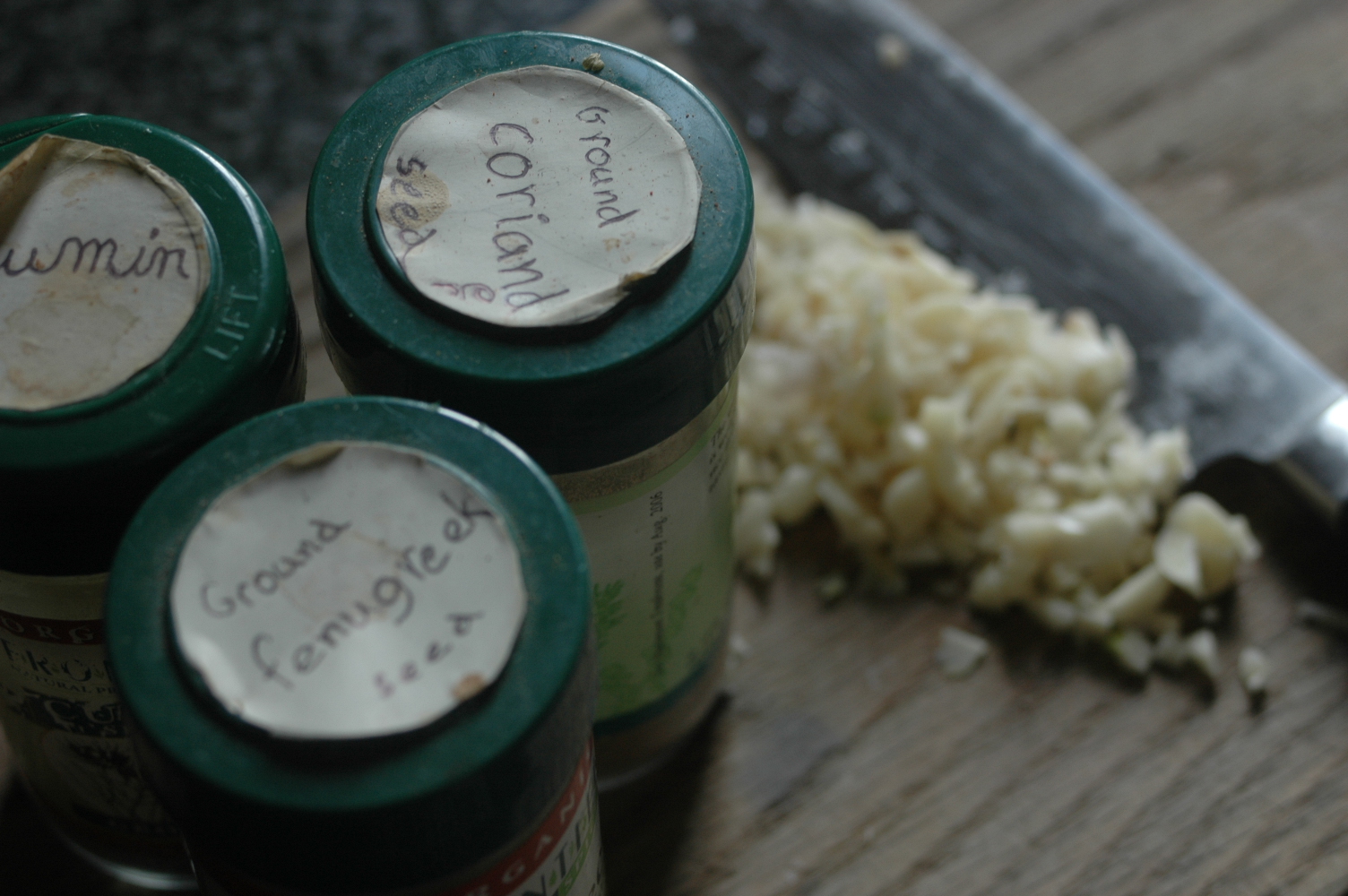

Once cold weather sets in, we eat some permutation of lentil soup, cheese, bread and roasted squash at least once a week.  I develop passionate relationships with lentil soups of various types.  I love one with fancy little green French lentils and olives and greens.  I love one with red lentils and lemon and carrots, one made with whey, and a spicy coconut one.


Presently I love this vaguely Indian one, and if precedent is anything to go by, I'll make it until everyone begins to groan and it is time to branch out again.  The slightly exotic lentils in play here (urad dal and moong dal) require soaking, which is unusual for a lentil.  But I do not grudge them the little bit of fuss that they demand, because their texture is so delightful.  Really any old lentil will do.  Stir some slivered greens into this soup, or don't.  Load it up with grated cheese on top, or don't.  Consider taking some plain yogurt and mixing in a little garlic, smoky paprika and lemon zest to dollop on top.  Call it dal, and serve it over rice, with pappadums to dip into it and a little cilantro on top. Or don't.  It will bear up, and bear you up, regardless.

lentil soup

3/4 c whole urad dal
3/4 c split green moong dal

1/4 c coconut oil, ghee, or olive oil
1/4 c minced garlic
1 T ground cumin
2 t ground coriander
1/4 t ground fenugreek (not essential, but very tasty)
pinch of ground cayenne
1/3 c tomato paste

salt to taste

Soak the lentils in water to cover overnight, and drain.

Heat the oven to 250 degrees.

Heat the oil in a heavy, lidded dutch oven, and sauté the garlic for a few minutes, until fragrant.  Watch carefully, stir constantly and keep the heat low, to prevent browning.  When the garlic is softened and nicely aromatic, stir in the spices.  Now add the tomato paste, letting it mingle and sweeten a moment as you stir.  Dump in the lentils, along with 7 cups of water.  Bring it to a low boil, turn off the heat, and cover the pot.  Slide the covered pot into the oven, and leave it there for a good long while.  About two hours ought to do it, depending on how old your lentils are, but longer will not harm it.  Stir it and test for doneness and salt to taste.  Like all lentil soups, it will improve if it cools and then you reheat it, at which time it may require thinning with a little water.


Friday, July 13, 2012

letting the freak flag fly


I am really hesitant to share this particular recipe because I am still living down a single episode from some years ago in which I was persuaded by a magazine article to make guacamole from peas instead of avocados.  Doesn't brown, you know.  To say this experimental maneuver enjoyed limited success would be something of an understatement.  ONE TIME I made this.  Once.  And yet here we are, years later, many decent meals to the good, batches and batches of proper, costly, fleetingly green, traditional and very tasty avocado guacamole down the gullets of those near and dear to me, and still I cannot live down this single rash act with the peas.

Furthermore, I catch a little flak here and there for weird health food things that go on in my kitchen.  Hippie food.  It alienates some people. I try to indulge in these things privately.

So when I was googling around trying to remind myself why chia seeds are good for me (I love them; I just needed to remember why that was such a good thing) and I ran across a recipe for hummus made from edamame and chia seeds, and my curiosity got the better of me, I decided to make it quietly and keep it to myself.  Frankly, the source of the original recipe was a little suspect (not distant enough from the chia pet image problem of these addictive little items, let's say) and I was doubtful of my potential success.  But my family found the stuff, and they ate it, and their friends did too, and they wanted to know how to make some for themselves.  So what I am saying here is, I already know this is hippie food, and weird hippie food at that.  No one needs to tell me that.  But also it can pass.  Even the suspicious seem to snarf it up.

If you are unconvinced of the merits of adding chia seeds to anything, you could make this edamame stuff without them and still be pretty happy, I think.

A note: it sounds like a lot of lemon juice, so much that you may think, as I did, that it is a typo.  While the original recipe was in fact chock full of typos (most of which I sincerely hope are expunged) and some odd choices involving sweet chili sauce (better believe I expunged that right the heck outta there) this bit about the lemon juice was not one of them. I started with a half cup, and by the end, wouldn't you know it but 3/4 of a cup was just about where I finished up.

chia edamame hummus

¾ cup lemon juice
¼ cup water
2 T chia seeds
2 to 3 t kosher salt
2 t ground cumin
1 pound shelled edamame
½ t ground coriander
½ cup tahini
3T extra virgin olive oil
pinch cayenne or dash hot sauce
handful chopped parsley
garlic to taste

In small bowl, mix the chia seeds with lemon juice and water, and set aside to bloom, by which I mean they will soak up quite a bit of liquid.

While this is going on, bring a small pot of water to the boil, salt it a bit and drop in the beans.  Cook 4 to 5 minutes, until bright but tender.  Drain and refresh with a cold water rinse.

In a food processor or blender, pulse the edamame, tahini, water, bloomed chia, garlic,  a portion of the salt, the cumin, coriander, olive oil and parsley until smooth, adding additional water as needed to create a good texture.  Taste and correct the seasoning to your liking.

Monday, April 30, 2012

pot of gold


We have a chicken making a weird, wheezy snorking noise today, and while I am not broadcasting an open plea for advice, I will share a little wisdom: if you happen to suspect that a chicken of your acquaintance may have an impacted crop, do NOT do any internet research while eating lunch at your desk.  Just take me at my word on that.

I was going to write you a nice little story about the beans in my lunch, but barnyarding and other Monday managerial tasks have absorbed all the time I had for that.  So no story.  Just beans.

That is what these are--just beans.  I've said before (more than once, in fact) that in my opinion, a person who starts the week with a giant pot of beans in the fridge strides boldly forward with a spring in their step.  Beans are my pals for many reasons: they can be bought without packaging, can be made ahead in quantity, improve on standing, are nutritionally dense, easy on the wallet, will usefully marry a myriad of flavors, can be employed in numerous ways and are very appealing to my children.

And there, I just said it again.

These beans are known, in my head, as "Dominican Beans," but when I tried to reconnect to the recipe that made me call them that in the first place, it was gone, and any other recipe I have found for Dominican beans is totally different.  They employ one stupendous trick--slow cooking in the oven in a covered pot-- that has the power to influence all your future bean projects.  But beyond that, they are unassuming, slipping happily into burritos, on to nachos, into baked dinners, mashing up nicely into refritos, sliding into a bowl with cheese on top and tortillas for dipping, etc. I make more than I might need for the week, and then I freeze one-cup portions of them for my future lunchbox- or snack-panicked self, and am always glad I did.

If you don't have a stove-worthy casserole dish, you can do the initial boil of the beans in a  pot and transfer them to a covered baking dish. The kombu helps to make the beans especially tender and digestible, but is entirely optional.

basic beans

2 cups dried pinto beans, picked over and soaked either overnight or by the quick soak method
2-3 cloves garlic, peeled & whole
2 t ground cumin
1T mild pure chile powder (ancho is nice; beware of "chili powder," which often contains salt and other spices, and thanks to the salt will toughen your beans)
optionally, a strip of dried kombu seaweed 

1/2 c finely chopped cilantro
1/2 c tomato puree, or 2T tomato paste 
 salt to taste

Preheat the oven to 350.  Drain the beans, and place them in a heavy casserole.  Add the cumin and chile, the cloves of garlic, the kombu if you are using it, and enough fresh water to cover by an inch.  Bring this mixture to a boil over medium to high heat, then turn off the heat, cover, and place the pot in the oven. Turn the oven down to 275, and go on about your day.  If you are bored or concerned, check the beans in an hour and see if they need a stir or some additional water.  They probably don't.  Check them again in another hour or so.  Are they almost tender?  You want to keep them in there until they are totally tender, and undercooking is more of a cause for concern than overcooking is.  I generally forget they are in the oven until I suddenly have to dash out somewhere, and then I just leave them in the switched-off oven until I get home.  Cooking time will vary based on the age of the beans, which is unknowable.  Life lessons abound in the kitchen.  

If you are using the kombu, you can remove it after an hour or so, while it is still intact, or just let it dissolve into the beans. 

Anyway, once the beans are tender, remove them from the oven and stir in the remaining ingredients.  These are tasty right away, but they vastly improve the next day and so forth.