Saturday, October 20, 2012
my roving eye
We didn't go hungry here, last week. But nor did we eat a lot of thoughtfully prepared, photogenic food while there was light enough to take its picture. Well, it was thoughtfully prepared--in advance of a trip I did not end up taking. Postponed at the last minute, after a whirlwind cookscapade. Which of the five dinners I made would you like tonight, I asked my kiddos yesterday after school, and as a result my son asked tentatively, at dinnertime, "is this for tonight?" as he eyed the green salad in front of him.
Speaking of food ideas banked against future needs, here are a few morsels I am tempted to try, when the dust settles.
First off, the smashed potato, which in fact we did try, and it was delicious. I boiled some not-very-large taters in salted water with a garlic clove until they were tender, cooled them down and flattened them between two cutting boards (quite satisfying). I had just roasted some cauliflower so I had a nice oily, parchment lined baking sheet handy, and I plopped them on there, drizzed more oil over top of them, sprinkled on a little cumin and paprika and sea salt, and baked them at about 400 until they were golden. Flipping was a fail for me, but you could try it if you feel brave and you have not, in your zeal, over-flattened (which makes them fragile--trust me).
I'd like to make this dukkah, though with almonds, because sadly I can't eat hazelnuts. I think you couldn't go too far wrong putting it on the potatoes.
These grape tarts, with their custard and thyme, make me drool, and I'm fiddling with a gluten-free pastry crust that will behave enough to adapt to it.
I don't mind the look of these pumpkin doughnuts one bit, especially since they are already gluten free.
I'd like to eat this bibimbap, possibly more than I'd like to make it myself, but enough that I am willing to try. Some day.
Tuesday, October 16, 2012
quince essential
Are you a quince resister? We shall overcome.
Here are a few points in their favor:
1. One of the greatest poems ever written, "The Owl & The Pussycat," by Edward Lear, features a quince:
They dined on mince,
and slices of quince,
Which they ate with a runcible spoon;
And hand in hand, on the edge of the sand,
They danced by the light of the moon,
The moon,
The moon,
They danced by the light of the moon.
Which they ate with a runcible spoon;
And hand in hand, on the edge of the sand,
They danced by the light of the moon,
The moon,
The moon,
They danced by the light of the moon.
Need more? Really? I thought the poem would do it. Okay:
According to Plutarch, who ought to know, ancient Greek brides would sweeten their breath by nibbling
on quinces before entering the bridal chamber, "in order that the first
greeting may not be disagreeable nor unpleasant." Plutarch may have overlooked some of the contributing factors to
disagreeable encounters, but he was right on the money about the quince. Awesome dental refresher.
How about its other ancient pedigrees? The legendary golden apple of Hesperides that Paris gave to Aphrodite (remember that one?) was really a quince. You know the apples in the Song of Solomon (best bible section EVER--come on! totally! "Strengthen me with raisins"!)? Well, you guessed it. They were probably quinces. Quinces were originally cultivated in Persia, and if there is a more poetic and enchanting ancient culture to think about (and connect your meal to) than that one, I am all ears to hear about it.
A quick trot through historical quince lore also turns up the belief that pregnant women who eat
generous quantities of quinces will give birth to industrious and highly
intelligent children. Probably not much of a stretch to extrapolate that eating quinces will make anyone brighter and more capable. Worth a try, anyway. Painless, to be sure.
If lack of historical grounding was not what was holding you back, but instead you have resisted eating them because you had a bad quince-chopping experience, or because you can't think of a single thing you'd like to do with them, I am about to put all your cares and woes behind you with a little nose-to-tail quince primer.
First and foremost, never approach a raw quince with chopping in mind. Before you and your knife get involved with the blessed items, roast them. The benefits are unlimited. Not only do you get a compliant fruit to attack with your knife, you also get (a) a house perfumed like ancient Persia, and (b) roasted quinces, which are my son's hands-down favorite thing to find in his lunch box.
Second, make this chutney. Make it in place of cranberry sauce at Thanksgiving. Make it and put it on some meat or vegetable that you have grilled or roasted. Make it and use it for chutney's highest and best use: the cheese and chutney sandwich.
Actually, in the case of this chutney, I think the highest and best use may be eating it out of the jar with a spoon, but a piece of toasted whole grain bread, some sharp cheddar and a glob of it on top will do you no harm.
Third, with the trimmings and tailings of the quinces, make some quince elixir (this sounds complicated and Persian, but really just means: boil stuff and then strain it). Tuck the jar in the back of your fridge. When the next sore throat comes around, and you know it will, warm this up with a little hot water. Thanks to all their pectin, quince seeds have a wildly demulcent quality that was used, way back when, to make lotion, and with good reason. The sore throat you are tending (which may not be your own) will thank you.
My canning coven makes this chutney in giant batches and then we can it, but you can make a small batch and refrigerate it (it's very acidic, so it should last quite a while), or eat it right up. The instructions are long because I am chatty, not because they are complicated. Chopping and stirring is what we are talking about here.
quince chutney and all its collateral benefits
about 12 medium quinces
2 cups sugar
juice of 2 lemons
1 cup water or apple cider
1 T minced fresh ginger
1/2 tsp ground cayenne pepper
1/2 tsp ground cumin
1/2 tsp ground coriander
With a towel, rub the fuzz off of your little yellow pals. Place them whole in a baking dish and into a 350 oven for 20-30 minutes, or until they are light brown all over and just soft to the touch and your house smells like heaven. They may require turning halfway through if they are crowded in the pan. You may want to stop here and just eat them all. I understand.
You can either peel them while they are whole and cut the bulk of the flesh off the core, or quarter them like you would an apple and then peel and core the sections. Some will be very pithy in the center. Cut them up not very carefully (it's a slippery business, but trust me, way better than trying to deal with them raw) into chunks of 1" or less. Don't fret over stray bits of peel, which will cook away.
Whichever method of butchering you use, save the cores and peels and pithy bits into a separate pot as you go, and when you are done coring and peeling (cut the cores open so the interior, seedy part is exposed, if you have not quartered them as you went), fill the pot with water and set it to boil, then simmer. Let it simmer a few hours, then strain off the now pink, thick (from the pectin) liquid and sweeten to taste with honey (preferably raw). You can add ginger root to this if you want--and I urge you to want that--just throw a few coin-slices of it in with the peels and cores. Use a very clean (rinse it with boiling water) jar to store this and it ought to last a while in the fridge. For an epic healing concoction, prepare Alana's magnificent garlic lemonade and mix it with a shot of this elixir.
Meanwhile, throw the quince pieces, the lemon juice and 1.5 cups of the sugar into a heavy pot with the water or cider, and bring to a simmer, stirring. Watch carefully and stir attentively to prevent scorching the bottom. Add more liquid if you need to, to keep things moving. When the quinces have softened entirely, mash things a bit with a potato masher and continue cooking until you like the consistency (it will thicken considerably as it cools, thanks to the pectin). Now add the ground spices, stir, and then after a minute or two more of simmering, taste to see how you like it. Add more sugar or spices as you see fit.
Friday, October 5, 2012
de-bunk mates
Has that Stanford study been bothering you? I mean the one that "established" that organic broccoli was no better for you than a Snickers bar--or so the media seems to have taken it. If it has been bothering you, filling you with a mute rage or an intense yet unspecific irritation, please read Mark Bittman's excellent article on the subject.
In it, he quotes a woman named Susan Clark of the Columbia Foundation, who says, “The researchers started with a narrow set of assumptions and arrived at
entirely predictable conclusions. Stanford should be ashamed of the
lack of expertise about food and farming among the researchers, a low
level of academic rigor in the study, its biased conclusions, and lack
of transparency about the industry ties of the major researchers on the
study. Normally we busy people would simply ignore another useless
academic study, but this study was so aggressively spun by the PR
masters that it requires a response.”
Are you not pounding the desk in triumphant agreement? My poor desk. I engaged in the same type of aerobic agreement when my daughter, listening to the post-debate analysis this week, said, "it sounds like they are talking about the Olympics--'He kind of turned out on the landing on that one move'--instead of the two potential future presidents of the country." She was right, of course--what we want to hear is 'HE WAS LYING! HE WAS LYING!' and instead we get, 'when he was lying about the economy, he really sounded presidential; on his lie about international policy, he could have lied with more vigor so the point goes to the opponent.'
Turning my soapbox lathering back to food, here is another good way to spend five minutes pounding the desk and saying "testify, my brother!": Michael Ruhlman's essay "Is Food Writing Important?" You might think it would only appeal to someone who is wrestling with self-doubt over this very activity, but in fact he tickles the same nerves that make a person wish to revoke funding for major universities that screw around with fundamental common sense and the people's investment in overturning the corporate stranglehold on our nourishment.
He makes the question anything but narrow:
"I dream of a day when we no longer need to be obsessed with food,
because that would mean that we had figured it out, we had all come to a
common understanding of how to grow our food, distribute it, and
consume it in ways that don't make us sick and crazy, but rather healthy
and happy; that, rather than being guilty, fearful, and intimidated by
food, we instead rejoiced in food; that we would cook together, with our
families and friends, and then sit down to share this cared-for food
and tell each other the stories of our day."
Thanks to the wise words of these two esteemed gentlemen, I have nothing to add but a little simple soup. You can make it in a snappy snap, and if you do, I hope you eat it with people you like, and you all feel happy together and have a story to tell about it later.
quick fall soup
3T olive oil
1 medium onion, chopped
1 small to medium butternut squash, peeled and seeded and chopped
1T curry powder (or you could just use a few teaspoons of cumin)
1 small can whole peeled tomatoes, drained and the liquid reserved, chopped
1 can coconut milk
about a teaspoon of salt
1 medium onion, chopped
1 small to medium butternut squash, peeled and seeded and chopped
1T curry powder (or you could just use a few teaspoons of cumin)
1 small can whole peeled tomatoes, drained and the liquid reserved, chopped
1 can coconut milk
about a teaspoon of salt
Heat the olive oil and saute the onion until it is nice and soft. Add the curry powder and stir a few times to heat it up. Add the squash and stir it around for a few minutes, letting it get a little golden on the edges. Throw in the coconut milk, the liquid from the tomatoes and about a cup of water, along with the salt. Bring to a boil and then reduce the heat; let it simmer until the squash is totally tender (the smaller you chopped it, the faster it cooks!). Now hit it with a stick blender (or puree it in batches in a regular blender--just don't burn yourself!), and then add the tomato pieces and taste for salt.
Monday, October 1, 2012
prepared food
There is a voracious, fanged creature that haunts my dreams. It is insatiable and cannot be delayed or deterred in the relentless pursuit of its hapless victim: me.
Here is a little artist's rendering of the perpetrator:
![]() |
| by Mark. A. Hicks |
The lunchbox is particularly fearsome because it does not work alone. Its cronies include dueling soccer games and violin lessons, meal-time dance classes and after-hours meetings. Anyone who stares down a week of three meals a day for as many people as live under their roof (let me do a rough calculation: ok, looks like every person lucky enough to have food to eat) faces a few moments in that week when What is Needed is not exactly What's On Hand.
I like to shore up my defenses on Sunday. I don't always make good on this intention, but when I do, the week seems to unfurl with a little less twitching and gasping at calorie time.
A monstrous pot of beans or black bean soup, a batch of fruit tapioca, custard or chocolate pudding--these are all Sunday money in the midweek bank. My rushed Wednesday self thanks my pajama & apron-clad Sunday self for stirring something up, and if I can siphon off a little bit of the soup or beans into a freezer container, the future Wednesday self whose Sunday pal decided to take that week off can still save herself a few steps.
I've yabbered before about Alana's car snack, a recipe for a granola bar-like item that she herself asserts is meant to be monkeyed with until it suits your niche of the marketplace. She has at least four versions of it, each with their passionate fans. I am not sure which version I started with anymore, but now I have a reliably repeatable rendition of my own that everyone around here seems to like.
An 9x13 pan of these bad boys forms the backbone of the lunchbox attack plan. Jimmy with it until you get it just how you like it, too.
go bars
1 stick of butter, or 1/2 c coconut oil
3/4 c honey (oil your measuring cup first)
2 c rolled oats
1 c crisp rice cereal (or you could use puffs, or cornflakes)
1/4 c oat bran
1/4 c flax meal
1/2 c almond meal
fat pinch of salt
a handful of dried apricots, chopped (or dried cranberries, or whatever you like)
about 3/4 c of chopped or sliced or slivered nuts--I like a combination of almonds and pecans
optionally:
3 or 4 pieces of crystallized ginger, minced
about half a cup of chocolate chips or chopped chocolate (*see the note below)
Heat the oven to 350 and tear off a piece of parchment that will line your 9 x 13 pan.
Melt the butter (hang on to that butter wrapper though--don't throw it out) and the honey together in a large pot, stirring all the while. Let it come to a nice boil over medium heat, then remove from the stove.
Add all the dry ingredients and mix well. Then add the fruits and nuts and mix again. *If you are adding chocolate, either be at peace with the fact that adding it now means it will melt, or alternatively be at peace with letting the mixture cool for about fifteen minutes before you add it. You can probably guess how my hamster-brain works out the math here, when we do the chocolate variation.
Glop the mess onto the parchment in the pan. Use a spatula to pat it out as smoothly as you can, and then reach for that butter wrapper and really whomp on it to tamp it down. Still do not throw away the butter wrapper.
Bake for about twenty minutes, until it is a lovely golden, toasty brown at the edges and the top looks solid. Set the pan on a rack and let it cool for about five minutes. Grab your trusty butter wrapper (you are old friends now) and resume the allover whomping and tamping. This greatly increases the chances that you will be able to slice these up into tidy squares. Cool down to almost room temperature in the pan, then while they are still slightly warm, use the parchment to slide the whole block onto a cutting surface. Using a large, sharp knife, portion them out into squares, and store in an airtight container, or wrap individualy in wax paper.
Friday, September 28, 2012
unhurried curry
Since you made the ginger-garlic paste (you did, right? you stepped away from the computer and plopped the three ingredients into your food processor and pressed the BINGO button, right?), maybe now you want to try that simple fish curry that Punty threw together, which is not exceptionally simple, in that a good number of ingredients and steps are involved, but is not at all difficult, in that the main skills required are stirring and the pressing of buttons. And the rewards are copious.
Fresh curry leaves are presently available in my local Healthe Foode Shoppe, but can also be mail ordered or purchased in a specialty Indian grocery and frozen in an airtight bag for nearly indefinite storage. Tamarind paste comes in dry blocks, which I am told is the best quality, but which must be soaked and pounded and strained; you can also buy it in a jar and this ease of use means its a compromise I make with no regrets. It keeps quite nicely in the fridge for longer than it takes me to use up a jar, which is a good long while.
Ready? Here you go.
andhra fish curry
3T olive oil
a fat pinch of ground turmeric
1 heaping T of the garlic-ginger paste
a handful of fresh curry leaves
2t brown mustard seed, whole
2 good-sized onions, peeled and coarsely chopped
1/4 c tamarind paste, thinned with a little water
2 heaping teaspoons of ground cumin
2 heaping teaspoons of ground coriander
crushed red chile to taste
3-4 tomatoes, coarsely chopped
2-3 t salt
About a pound of shrimp, cleaned, or firm white fish, skinned and cut in chunks, or frankly, potatoes, peeled and boiled until firm tender and quartered, or for that matter probably boneless chicken
First, put the onion into the food processor and pulse/chop until you have a nice puree. Scrape out into a small bowl and reserve.
In the same food processor bowl, without washing it, puree the tomatoes, and reserve those as well.
In a large pot over medium heat, warm the olive oil and add the turmeric to it. Let that warm through. Now add the ginger-garlic paste, and stir that around a minute. Throw in the mustard seed and the curry leaves. Stir. Now dump the onion puree in, and stir and cook and stir and cook and stir and cook (it is helpful to have something not very absorbing to think about, or someone charming to talk with as you do this). You want it lightly brown, and you want to take your time about it. As it begins to brown, it will begin to stick, and then you dribble in a little water to keep things moving nicely. Take 15 minutes or so for this. You are building up some serious flavor. The whole trick is in this stage--taking your time with it and letting it brown slooowly.
Now add the other spices (cumin, coriander, chile) and let them warm through, and then stir in the tamarind paste-water mixture and the salt, followed after a few stirs by the tomato puree. Simmer it for several minutes to let it thicken and mingle. You can stop at this point and set it aside and it will only improve. You can also press onward, and add the protein of your choice or potatoes and let them cook in the sauce and really soak up the flavors.
Serve it over rice. Punty says you should lightly stir-fry some baby bok choy in oil with a pinch of salt and red chile flakes to serve on the side, and I am not one to argue with her.
Wednesday, September 26, 2012
fully fed up
My sister has a shockingly beautiful friend named Purnima, which is already a pretty lucky thing to have, and when you consider that she is called Punty, and is the kind of cook whose meals make the people who have eaten them get misty in the recalling, and that she came over recently and gave me a cooking lesson--well, the luckiness factor just multiplies exponentially.
She was planning to teach me how to make a simple fish curry, and she did that. But even a simple fish curry has a lot of steps. I am reluctant to tell you how to do anything that has a lot of steps, generally. There are layers and layers of flavor in a good curry, and you do not get those in a snap, unless you buy a jar of what a friend of mine calls Curry In A Hurry, and then you have something, but not anything you would serve to Punty or that would make anyone terribly misty when they recalled it. This is not to say that some of these jiffy products are not tasty enough to fall back on when you must. Some of them are. But they are not what we are talking about.
Punty said she did not learn to cook as a child in India. She just ate. But when she moved to the U.S. and found herself to be a homesick and hungry student, she began to try to piece together what she had witnessed and what she was hungry for and to reconstruct it in her little kitchen. The rest is history. My nephew cannot speak of Punty's food in public because the weeping compromises his manliness. "Her breakfast..." he says, and has to clear his throat. Punty told us a hilarious family story about an Indian gentleman declining an offer of more food by saying politely, "Oh, no, thank you. I am fully fed up." Max has been fully fed up by Punty more times than he can count, though I think on nights when he can't sleep he is happy to try.
One of the steps on the road to Punty's fantastic curry was the one where she said, "does your family like it hot?" and I said (thinking of the innocent little children) probably not by her standards, and so she said, then we will add only a little pepper.
This is a visual on "only a little pepper," Purnima-style:
Another one of the steps was this paste, which did not take very long to assemble at all, and which is the topic of our discussion today. "We will make a lot," said Punty, "because it is very useful to have on hand."
She was right about that.
Here is one thing you can do with this paste: when you melt butter for popcorn, drop a tablespoon of this in there and let it bubble a bit. You would never (or anyway, I would never, no matter what you suspect) make garlic and ginger paste as part of the process of producing a bowl of popcorn. If you happen to have a jar of it lurking in the condiment forest of your refrigerator, however, you have this kind of option before you. And then you also have this kind of popcorn. Salt it as liberally as you generally would, and maybe get a little nutritional yeast on there. Never look back.
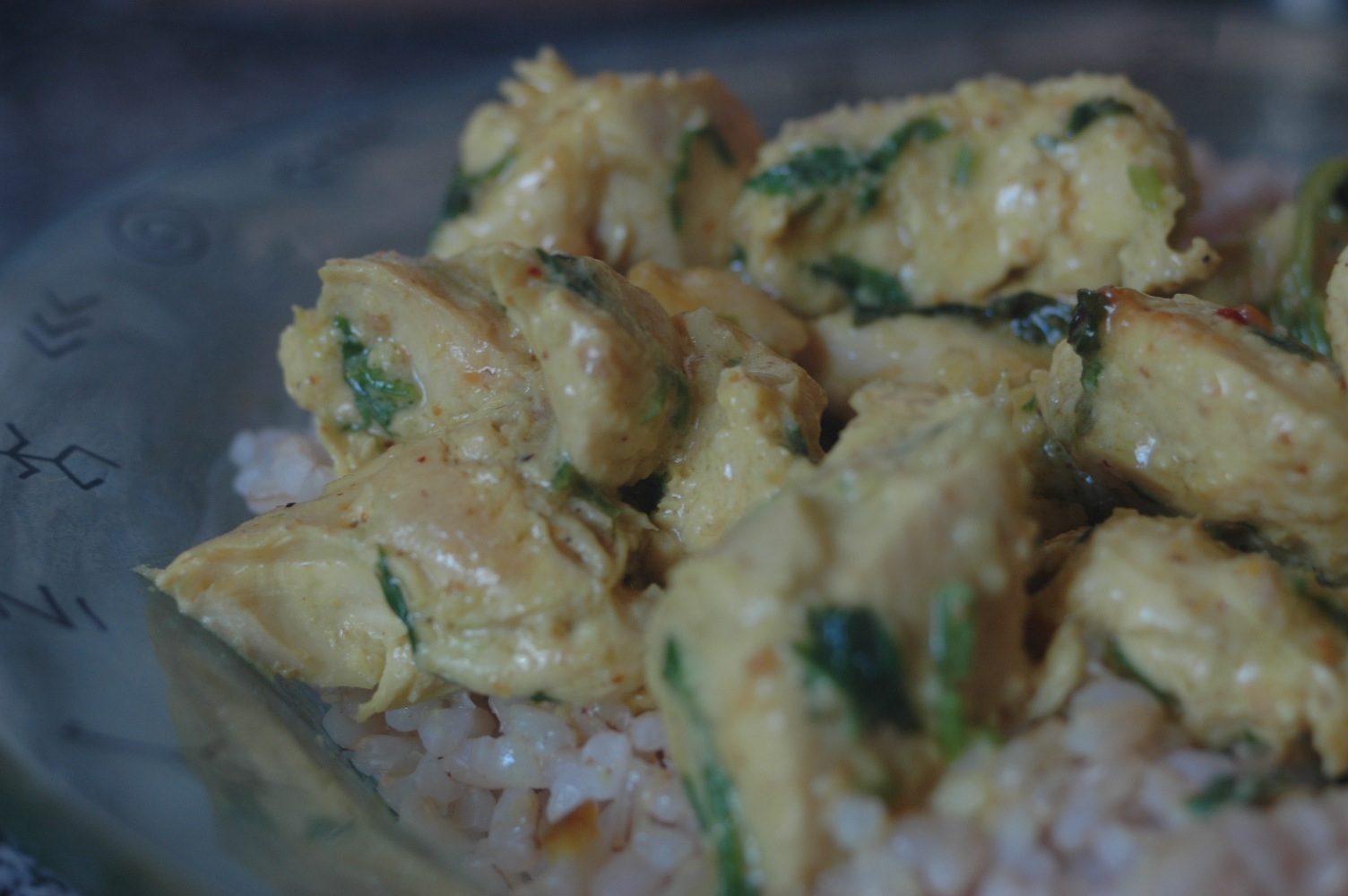
Here is another, perhaps more useful thing you can do with it. Make a fast and fantastic and pretty memorable for a weekday curry for dinner. Curry in a hurry, Punty-style. With a pot of rice, you are set to jet.
the paste
a head of garlic, peeled
about 3" of fresh ginger root, peeled (peel it with a teaspoon--it will change your life)
1 small hot pepper, seeded (a jalapeño, for example)
Coarsely chop the ginger and the pepper, using all proper and prudent precautions regarding not touching your eyes or other tender areas after touching the pepper. Put all three ingredients in the bowl of a food processor and pulse to combine, and then really mince the hell out of them. Maybe add a little water if you need it to get things moving. You want a smooth and uniform paste. Put it in a glass jar with a tight lid, and keep it in the fridge for up to two weeks, if you can manage to hang on to it for that long.
the curry in a hurry
about 3T of canola oil, ghee, butter, or coconut oil
about 2T of ginger-garlic paste
about a T of curry powder
about a pound of chicken breast, chopped, or tofu, cubed
about half a cup of half and half or coconut milk
about half a cup of chicken broth or water
salt to taste
a large handful of baby spinach
a large handful of chopped cilantro (or not, if you hate it)
Heat the oil in a heavy skillet over medium heat. Add the paste and stir it around for about five minutes, letting it golden up a little but not brown at all. Add the curry powder and stir a few times. Doesn't that smell nice? Add the protein and sear it well on all sides. Now add the liquids and simmer a few minutes, scraping all the tasty stuck bits off the bottom as you go and letting the sauce thicken a bit. Throw in the green things and the salt, and taste.
Monday, September 24, 2012
the hot sweet
A late-afternoon moment this weekend found me and my daughters gobbling raspberries and grapes off the bush and vine, respectively, like bears laying it in for the long winter sleep. For many reasons, certainly including the golden September light, it was heavenly.
Faced with a perfect grape, or berry, or peach, or moment, sweetness is enough.
Another moment this weekend found me wanting to make an apple crumb bar. This can happen to a pie-averse person in New England in the fall, even in a year (like this one) that is pretty light on apples. In this case, sweetness didn't seem like it would, in fact, be enough. The idea of an apple bar lightly seasoned with (snore) cinnamon made me feel tired. I found I was thinking of a spicy apple bar, and let me tell you, my thoughts did not run to nutmeg.
A little toodle around the Interwebs reminded me of another thing that's very hot and now, which is caramel, especially with salt in it. I generally hide under the couch when the Hot and the Now are out and about, but I do like caramel. My grandmother used to send little kits with sheets of caramel and wooden sticks to make caramel apples. I am pretty sure we just ate the caramel sheets neat.
A number of bars trotted across the screen with caramel sauce in them. But they all said, 'oh, how nice, an apple bar, sleep well,' to me. I wanted something with a little more presence. I know every other thing that doesn't have bacon (so hot! so now!) in it all of a sudden
has chiles (very hot, very now), but trendiness aside, I really do like a little heat with
the sweet.
A plan began to take shape.
Having gone on record that caramel sauce is a snap to make, I stand by this assertion. I also stand by the assertion that I had 10 caramels from Trader Joe's left over from assembling some party bags, and thanks to that I could move from plan to action like a sprinter. By all means make your own caramels. Homemade caramels are excellent for your self-esteem. But you don't have to make them, for this. I won't tell anyone.
There's some nutritional merit to these bars, though I don't think that will register for most of the people you feed them to. I used white whole wheat flour, but I bet you could use regular and still not be found out. You could replace some of the whole wheat flour with almond meal, if you wanted to enhance the healthy aspect of things, or even add some nuts to the filling if that appeals.
APPLE BARS
base & topping
1.5 cups whole wheat flour
1/3 c sugar
1/4 c flax meal
1/2 t baking powder
pinch of salt
pinch of cinnamon
1 stick of butter (half a cup, or 8T), cold
1 egg, beaten
filling
1 t red pepper flakes
2 t finely grated fresh ginger
1 large apple, peeled, cored and chopped in about 3/4" dice
2t cornstarch
1T sugar
10 caramels, chopped up
A fat pinch of coarse, flaky salt
Heat the oven to 375. Lightly butter an 8x8 baking pan.
Combine the dry ingredients and cut the butter into them until you have a coarse, mealy texture. Pour in most of the beaten egg and toss everything together; you are aiming for a crumbly dough that will come together when you squeeze it. Add more egg if you need it, and even a splash of water. But keep it crumbly, overall.
Pat 2/3 of this mixture pretty firmly into your prepared dish, and set it aside. Reserve the remaining crumbly bits separately.
Toss the apple chunks with the sugar, ginger, chiles and cornstarch. Now toss in the caramels and the salt, and then spread this out on the waiting crust. Crumble the reserved dough on top of this, and bake for about 35 minutes, until the crust is golden and firm. You can spoon it out while it is hot, but for cutting purposes, best to cool completely before slicing.
Subscribe to:
Posts (Atom)