Showing posts with label soup. Show all posts

Wednesday, November 28, 2012

squash court


I came into possession of some gorgeous poblano peppers, which have been looking mighty fine in the market even as all the produce around them begins to show signs of jet lag.  So I set out to make my friend Julie's "Three Sisters and One Spicy Brother" squash soup, which is some mighty soup, but when I unearthed the recipe in my bin of scraps and magazines, I found I lacked a few of the things required to produce it.  The principle missing ingredient was time: one of the sisters is white beans, and I did not have time to soak and cook them.  There was no big, looming deadline, really--I just wanted this soup for dinner. 

Right behind her recipe in the bin was an old squash soup of mine that was pretty tasty, as I recall.  But sitting there on the counter next to Julie's recipe and the peppers, it started to take notions into its head.  A hybrid version resulted.

I've made it a couple of times now, because the poblanos continue to wink and sparkle at me as I troll the store wishing it were still summertime (only from a produce standpoint), and each time I forget how I did it the time before and still end up with something that makes the consumers pretty happy, so my net opinion is that you cannot go very far wrong combining these ingredients. If you are curious, the main difference is that sometimes I leave the bulb end of the squash whole and roast it, and then mash it, and sometimes I dice the whole squash and cook half of it with the aromatics in the soup pot, and then puree it all together with my trusty stick blender.  No obvious difference is apparent.  I gave you the half and half method below, because it spares you peeling and chopping the peskier bulb end while it is raw, but it's your call.

There's some grunt work involved.  Can't lie about that.  

Butchering a butternut squash is aerobic work, and you have to get a pan and the oven involved.


And there are the peppers to roast, and otherwise attend to.


Plus some mincing around, and further chances to practice your knife skills.


But once all the prep work is done, the soup itself comes together in a snap. 

And then you get to eat it.


two sisters and one spicy brother soup

2 or 3 poblano peppers
1 large butternut squash
3T olive oil, divided
1 large onion, finely chopped
3 cloves of garlic, minced
1" of fresh ginger, peeled and finely chopped (not too fine)
2-3t ground cumin
3/4 t salt
1 chipotle pepper in adobo sauce (see note), finely minced
10 oz frozen corn kernels
1 c chopped fresh cilantro, or basil as an alternative

Roast the poblano peppers over a gas burner flame or under the broiler until well charred all over.  Plop them into a small bowl and cover it, so the trapped steam can loosen the skin for you.  Once they are cool enough to handle, do the messy work of slipping their peels off, seeding them, and chopping them up into a quarter-inch dice.  Try to resist the urge to rinse them, as they lose roastiness when you do. Stray bits of charred peel won't harm the end result. You can do this a day or two in advance if you like.

Heat the oven to 425.  Line a baking sheet with parchment paper and also grab a medium baking dish. Hack the bulb end of the squash off the neck end.  Stand the bulb end on its cut side, halve it, and scrape out the seeds. Place the bulb ends, cut side down, into the baking dish with a little water and slide it into the oven while you continue to wrestle the rest of the squash into submission.

Slice off the stem end and stand the neck section up on the cutting board.  Slice vertically from stem to stern, into half-inch slices, and then go about peeling those and chopping them into cubes that will fit nicely in your soup spoon.  Toss them with a tablespoon of oil, and spread on the baking sheet. Roast the cubes about 25 minutes, until just golden and tender.  Keep the bulb ends in there all this while, and when they slump a bit, they are ready to come out, too.  Set all of this aside to cool.

Heat the remaining oil in a large, heavy pot.  Saute the onion until it begins to soften and lightly brown, then add the garlic, ginger, salt, cumin and chipotle and keep cooking until it is all nicely fragrant, about another minute.

Now scrape the cooked flesh from the bulby parts of the squash into the pot, and thoroughly mash it around with your spoon until it is pretty smooth.  Add about 6 cups of water, the roasted squash cubes and the corn, and mix everything very well. Bring it to a simmer, and let it cook for about ten minutes.  Stir in the cilantro, and taste for salt and heat.

The promised NOTE on the chipotle peppers: little cans of these are sold in the Latin or Spanish section of most every grocery store.  I buy a can about every six months, dump the contents of the can into a small tub, jar or freezer bag, and use it as I need it.


Monday, November 19, 2012

reasonable FAQ simile


Sometimes the best defense against looniness is a fertile imagination.  Of course, sometimes looniness and a fertile imagination look a lot alike, so you have to be careful.  

When I was single and living in New York City and kind of tired and perhaps it's fair to say a little bit lonely, I took a page out of my preschool pupils' book and conjured up an imaginary friend for myself.  Unlike the little girl in my class who spent a good portion of the morning sitting in her coat cubby having an animated conversation with her pal, I kept it kind of discreet.  What works when you are three begins to look a little silly when you are in your mid-20's (this rule of thumb applies to more than just social skills).  But I got full mileage out of my mental companion.  Though companionable, he was really more of an imaginary valet or personal assistant--more Jeeves than Pooka.  Racing from teaching to graduate school, I would think of all the little tasks I could slough off to Gustavo (he looked kind of like Raul Julia), like picking up my laundry or ironing my clothes or shopping for groceries or getting me a plane ticket to Paris (double imaginary points).  I took the time to imagine he would always pick up fresh flowers while he ran these errands, but let the record reflect my assertion that I never once actually spoke out loud to him or left him a note.  I swear.

No more graduate school in my life now (there are days I wish I was in school, but far more of them when I thank my stars that I am not).  No more lonely.  So Gustavo has retired.  As I move from roasting to chopping to whipping, from the holiday parent assembly to the holiday floor-mopping, my defense against any encroaching looseness on the grip of the sanity controls takes the form of the imaginary mailbag.

Dear Raisin,

What are you making for Thanksgiving?

Dear Raisin,

Thanksgiving this, Thanksgiving that.  What do I feed everyone between now and Thursday, and still have time to make Thursday happen?

Dear Raisin,

Congee is nice, but do you ever wonder about all that whiteness being good for you as you eat bowl after bowl of it?

Dear Raisin,

Am I better off simplifying things as much as possible in order to preserve the time, energy and sanity necessary to have a pleasant, lucid, seated conversation with friends and family, or should I give in to temptation and make all 7 kinds of brussels sprouts that I have bookmarked?

No one outside of my head has actually asked me any of these questions.  But the answers are so easy to provide that the mere act of answering them will give me all the lift I need to sail through the next few days like a float in the Macy's parade (thank goodness for stretch pants).

If you really want to know what I think I may make for Thursday, head over here, where I have a handy list.


If you, like me, face the predictable and unpredictable caloric needs of groups of humans ranging from two to seven (in number) and 7 and three quarters to 88 (in age), then questions two and three, above, have one answer: brown rice congee, which is demystified below.


In answer to question 4, the market is probably out of brussels sprouts anyway (such is the present demand), so you are better off sticking to the one type and safeguarding all your faculties for a confab with your Aunt Matilda.  Heaven help you selecting which recipe, though.  I am still weighing my options.  There is so much I wish to sit still and be grateful for, though, that I will force myself to choose.


brown rice congee


You are going to get a monster headnote here, but the recipe is easy as can be, especially if you have already made the white rice version and consequently do not have to spend any mental energy wondering if this is going to work despite how weird it sounds.


The main differences are, not surprisingly, more water and more time.  Despite the hours of cooking, it basically cooks itself, so can be left to its own devices on a back burner while you make tracks to Turkey Town on the front ones.


Just like its paler cousin, the brown rice version is equally happy made plain, or with tiny slivers of fish or chicken.  It is particularly happy as pictured above: with a tangle of dark greens or broccoli, stir-fried with plenty of garlic and ginger and tamari, and maybe some of this (or whatever equivalent you have handy) on top. Its grainy simplicity is a nice ramp-up to (or recovery from) the digestive olympics on Thursday.

I doubled the batch, which produces a metric ton and will mean that any time anyone is hungry or you are called upon to feed your family in the present despite the peeling and chopping you are doing for their future nourishment, you can just grunt and gesture with your elbow to the pot of congee, from which they are welcome to help themselves.  But you can halve it if you like, in which case you can probably add all the water at once (it wouldn't all fit in my pot; had to cook down for a while first).


2 c short-grain brown rice

24 c water
2t kosher salt

optionally: 1 whole boneless chicken breast, partially frozen (really--makes slicing enormously easy)
2t cornstarch (optional)

Put the rice and water (as much of it as will fit) into a large, heavy pot and bring it to a boil.  Lower the heat to a gentle simmer, and cook and cook and cook, stirring occasionally, for about 4 hours.  While the white rice version requires focused stirring at the outset, to get the grains in good suspension in the water, this one doesn't really demand that until the last hour, when you will want to stir at shorter intervals so you don't scorch the bottom.  This is when I added the last four cups of water, as well, because they would not fit before then and because the increasing thickness demanded it.


When the mixture looks like soupy oatmeal, you are done.  Stir in the salt, and serve it with something delicious on top.


If you'd like to add the chicken, use a very sharp knife to slice the breast very thinly cross-wise, and then stack these slices and cut them into thin ribbons.  Toss the chicken slivers with the cornstarch, and stir them into the hot congee.  They will cook almost instantly.  If there is a reason that you don't want cornstarch, just omit it; no substitution is necessary.


You can also sliver up some fish to add similarly, or get your protein another way by adding some crumbled-up firm tofu to your stir-fried greens.


Thursday, November 15, 2012

in which I roast to the occasion


When I took my son for his riding lesson yesterday, one of the horses at the barn was getting his hair clipped in such a way as to accommodate his snappy winter jacket.  In order to calm this jittery horse for said procedure (buzzing clippers!  touching of personal areas!), he had been fitted with a twitch, which is an item, not a symptom, and is intended to calm the animal by encouraging a release of endorphins.  

Take a look at this picture and let me know how many of your personal endorphins you think would be released if you were outfitted similarly:


Yes, that is a large metal clamp on his nose, or lip, depending on how you view such matters.  Were I to take a tip from the animal kingdom in the management of my own jitters, I think I would lean more towards the Thunder Shirt, a snug vest I have seen in use on several dogs of my acquaintance, which takes them, in one press of the Velcro, from "HOLY GREAT GOOD GOD I THINK THAT MAN HAS A HAT ON AND I AM CERTAIN THAT MEANS HE WANTS TO KILL ME" to "oh, what, is that, like, the doorbell?  Missed it." 


photo by tales & tails
I am not being paid to promote their product, but if as a result of this post, the good people over at ThunderShirt decide to send me a case of same (size Large, please; not fussy about the color) to pass around the holiday table, I am prepared to conduct a human trial.  I think it is the correct season for that.

Now that we have led the conversation about stress around to the dining room, let's talk about soup.  

I think I have nattered before about the cookbook from Greens Restaurant, which I admire, and its tendency to list among the 17 ingredients for a dish "one batch of X, p. 138," which turns out to be a 3 page recipe itself, with numerous ingredients and various stages of preparation.

Generally, I try to avoid preparing (let alone exhorting you to prepare) anything that has a preamble of this nature.  But I am not sure we can go on like this if you don't throw together a batch of vegetable stock concentrate.  It's the backbone of winter soups, and I go on and on about soup once the temperature dips below 64 degrees.  Vegetable stock concentrate has an enormous potential for making you feel like the heir apparent to the Rock Star throne of the universe, given its ease-of-preparation-to-usefulness ratio.  And I am reminding you of it now, when you may be abusing yourself about the need to bake for holiday giving.  Hint: no one will mind not receiving more cookies.  And no one will mind AT ALL being handed a jar of this stuff in place of a cookie basket.  Instead of cursing you as they heave onto the Stairmaster in early January, they will build a little altar to you in their home, and keep it stocked with incense and orchids and tropical fruit at the peak of ripeness.  Maybe.

If you do not have a copy of the River Cottage Preserves cookbook, then thank your lucky stars that Laura posted the recipe for this stuff on her blog.  When I make it I add a couple of stalks of celery as well as celery root, and I use thyme instead of cilantro, because it seems more one-size-fits-all.  But it's hard to go very far wrong, I think.


If you don't make the stuff, you can still live a happy and fulfilling life, because you can leave your comment here and possibly be the person I send a jar to.  Go ahead. It's not a Giveaway exactly, not another excuse for me to go all Ryan Gosling on you.  I've sworn off those, because they are deeply demoralizing.  So this is something entirely different.  You don't even have to say anything.  You can make an empty comment, in the spirit of the political season.  Or a full one, in gratitude for the thin margin by which we avoided certain doom.


So you might receive a windfall jar, if you do that.  


You can also just salt your soup.  You will still have tasty soup, but if you are wondering if it will be that much tastier if you take the (minimal) trouble to make the paste, you will be right.  It will be that much tastier.

Are you not convinced yet? Should I mention that for your (minimal) trouble, you will end up with several jars of the stuff, and it keeps forever (roughly), so if you don't give any away, you will be rolling in the stuff for months to come?  Did that do the trick?


Meanwhile, thanks to historic levels of personal tension, I seem to be stuck on two settings in the kitchen: 'Bake For Comfort and Distraction' is one, and 'Leave It Kind Of Late To Get Dinner Together; Punt and Roast Something' is the other.


So here is some roasted soup.  I made this the other night and my middle child said, "well, thanks a lot.  You have ruined me.  I can't ever eat any other soup than this one."

Enough said, in my view.


forsake all others tomato soup


1 medium bulb of fennel, trimmed of stalks and thickly sliced

2 large carrots, peeled and cut in chunks
1 large or 2 medium leeks, white and light green parts, quartered and cleaned
1 medium onion, peeled and thickly sliced
2T olive oil
coarse salt and fresh pepper

2 T butter, or more olive oil

2 cloves garlic, finely chopped
28 oz canned tomatoes (whole or ground or puree)
2-3 T vegetable stock concentrate, or salt to taste
1/3 c half and half, optional but worth it

Heat the oven to 400.  Line a rimmed baking sheet with parchment (or live dangerously and go commando), and spread the prepared vegetables on the tray in a single layer.  Drizzle them with oil and sprinkle a bit of salt and pepper over them.  Roast about 15 minutes, until starting to brown, then switch the oven off and leave them in there to soften up a little more in the residual heat.


Heat the butter or olive oil in a large pot, and sauté the garlic in it for about a minute.  DO NOT LET IT BROWN, or you will experience a nasty flashback to the late 80's when everything was flavored with "toasted" (a/k/a 'burned') garlic.  Feh.  Add the tomatoes and heat them through. Now add the roasted vegetables, two tomato containers full of water, and the stock concentrate (or about a teaspoon of salt).  Attack the soup with a stick blender, or process in batches in a regular blender, observing all common sense precautions regarding hot liquid and expansion, until you have a thick, smooth purée.


Stir in the half and half, and taste to correct the seasoning as you like it.  Go all restaurant and garnish with a drizzle of lemon oil or minced fennel fronds or some creme fraiche swirled in pretty patterns or casually rustic crumbles of goat cheese, or just eat it.


And don't forget to leave a comment if you want a shot at a jar of redemption. 

Thursday, October 25, 2012

what you can rely on


[A quick aside: comment-making on this site, which may have been tricky for some of you before, has just had a makeover, so please give it a try and let's see if it works now.]

Certain things in life can be counted on.  For example, if you forget your umbrella, it will rain very hard.  If you are running late, there will be traffic.  If you are early to meet someone, they will be late, and vice versa.

This is known as Murphy's Law.  Murphy was a real guy, it turns out, and pretty cranky about the "commonplace" interpretation of what he set out to posit as a serious principle of defensive design.  We regular old nimrods who do our thinking outside the field of aeronautics take his law to mean, simply, than anything that can go wrong, will.  Apparently there was some more nuance to it.  Nimrod, you may as well know, was also a real guy (the great-grandson of Noah), and he did not live long enough to see our feeble-minded culture sully his good name with insulting associations, perishing as he did long before Elmer Fudd came along, and so probably he was not cranky.

If you would like to read an excellent piece of writing decrying the low-down, dirty practice of name-calling, look no further than here.  Take that, snarky Ann Coulter.  Take it and get back on your broom.

If you would like to know why I am prattling on about Murphy's Law and restored faith in humanity when I meant to be talking about lentils, all I can tell you is that it traces to my having attended the Parent Education Night event that was the concluding element of the driver's ed process for my oldest daughter.  Commonplace interpretations of the Murphy legislation were all over the place.  If you are tired, and slightly freaked out by life's recent twists and turns, and are among the few who are more or less on time to class, it will follow that several people will prance in up to half an hour late and suffer not even the slightest reprimand, and that the instructor will have--through no fault of his own--both a tendency to trip over the same spot on the carpet every time he paces across it (which is often, as he favors a mobile and frisky lecturing technique) and a set of odd habits (weird coughing!  repetitive phrasing!) that once you notice them, make it impossible for you to form a coherent thought about anything but this.  It will follow that you will run out of yarn on the project you brought along about 45 minutes into the 2 hour class, and that after he shows you the petrifying video about the bereaved parents of honor students who brought a smile to the face of everyone they met before their untimely and preventable, grisly ends, the instructor will say not once, not twice, but seven times, "imagine you are one of those parents!"

And there is nothing for it but lentil soup.  Lentil soup sends you off into this dark night fortified, it waits patiently at home for the staggered and staggering arrivals of the rest of your family, and its tiny leftover amounts morph magically the next day into lunch for three. 


Once cold weather sets in, we eat some permutation of lentil soup, cheese, bread and roasted squash at least once a week.  I develop passionate relationships with lentil soups of various types.  I love one with fancy little green French lentils and olives and greens.  I love one with red lentils and lemon and carrots, one made with whey, and a spicy coconut one.


Presently I love this vaguely Indian one, and if precedent is anything to go by, I'll make it until everyone begins to groan and it is time to branch out again.  The slightly exotic lentils in play here (urad dal and moong dal) require soaking, which is unusual for a lentil.  But I do not grudge them the little bit of fuss that they demand, because their texture is so delightful.  Really any old lentil will do.  Stir some slivered greens into this soup, or don't.  Load it up with grated cheese on top, or don't.  Consider taking some plain yogurt and mixing in a little garlic, smoky paprika and lemon zest to dollop on top.  Call it dal, and serve it over rice, with pappadums to dip into it and a little cilantro on top. Or don't.  It will bear up, and bear you up, regardless.

lentil soup

3/4 c whole urad dal
3/4 c split green moong dal

1/4 c coconut oil, ghee, or olive oil
1/4 c minced garlic
1 T ground cumin
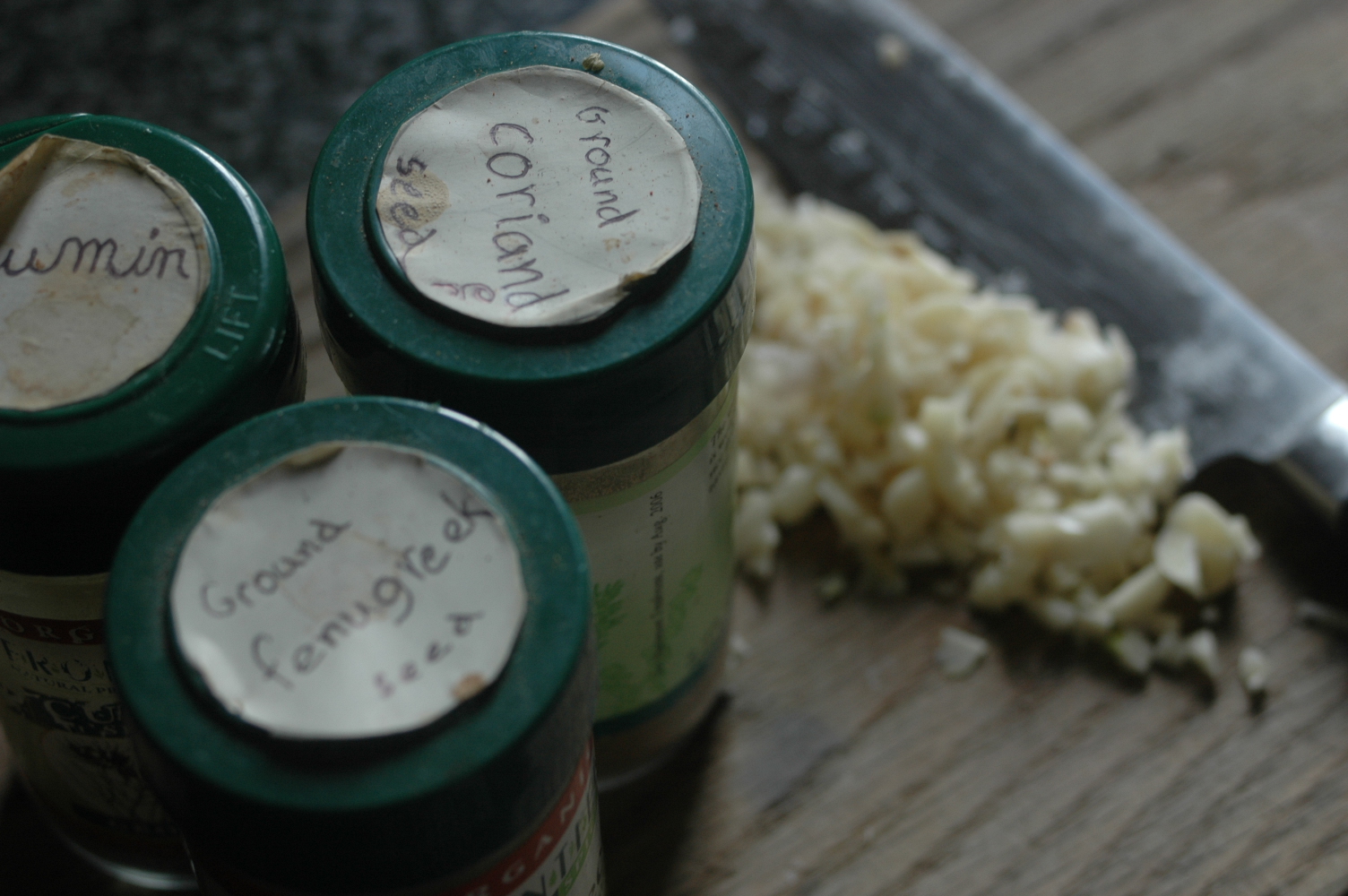
2 t ground coriander
1/4 t ground fenugreek (not essential, but very tasty)
pinch of ground cayenne
1/3 c tomato paste

salt to taste

Soak the lentils in water to cover overnight, and drain.

Heat the oven to 250 degrees.

Heat the oil in a heavy, lidded dutch oven, and sauté the garlic for a few minutes, until fragrant.  Watch carefully, stir constantly and keep the heat low, to prevent browning.  When the garlic is softened and nicely aromatic, stir in the spices.  Now add the tomato paste, letting it mingle and sweeten a moment as you stir.  Dump in the lentils, along with 7 cups of water.  Bring it to a low boil, turn off the heat, and cover the pot.  Slide the covered pot into the oven, and leave it there for a good long while.  About two hours ought to do it, depending on how old your lentils are, but longer will not harm it.  Stir it and test for doneness and salt to taste.  Like all lentil soups, it will improve if it cools and then you reheat it, at which time it may require thinning with a little water.


Friday, October 5, 2012

de-bunk mates

Has that Stanford study been bothering you?  I mean the one that "established" that organic broccoli was no better for you than a Snickers bar--or so the media seems to have taken it.  If it has been bothering you, filling you with a mute rage or an intense yet unspecific irritation, please read Mark Bittman's excellent article on the subject. 

In it, he quotes a woman named Susan Clark of the Columbia Foundation, who says, “The researchers started with a narrow set of assumptions and arrived at entirely predictable conclusions. Stanford should be ashamed of the lack of expertise about food and farming among the researchers, a low level of academic rigor in the study, its biased conclusions, and lack of transparency about the industry ties of the major researchers on the study.  Normally we busy people would simply ignore another useless academic study, but this study was so aggressively spun by the PR masters that it requires a response.”

Are you not pounding the desk in triumphant agreement?  My poor desk.  I engaged in the same type of aerobic agreement when my daughter, listening to the post-debate analysis this week, said, "it sounds like they are talking about the Olympics--'He kind of turned out on the landing on that one move'--instead of the two potential future presidents of the country."  She was right, of course--what we want to hear is 'HE WAS LYING!  HE WAS LYING!' and instead we get, 'when he was lying about the economy, he really sounded presidential; on his lie about international policy, he could have lied with more vigor so the point goes to the opponent.'

Turning my soapbox lathering back to food, here is another good way to spend five minutes pounding the desk and saying "testify, my brother!": Michael Ruhlman's essay "Is Food Writing Important?"  You might think it would only appeal to someone who is wrestling with self-doubt over this very activity, but in fact he tickles the same nerves that make a person wish to revoke funding for major universities that screw around with fundamental common sense and the people's investment in overturning the corporate stranglehold on our nourishment.

He makes the question anything but narrow: 
"I dream of a day when we no longer need to be obsessed with food, because that would mean that we had figured it out, we had all come to a common understanding of how to grow our food, distribute it, and consume it in ways that don't make us sick and crazy, but rather healthy and happy; that, rather than being guilty, fearful, and intimidated by food, we instead rejoiced in food; that we would cook together, with our families and friends, and then sit down to share this cared-for food and tell each other the stories of our day."

Thanks to the wise words of these two esteemed gentlemen, I have nothing to add but a little simple soup.  You can make it in a snappy snap, and if you do, I hope you eat it with people you like, and you all feel happy together and have a story to tell about it later.

quick fall soup

3T olive oil
1 medium onion, chopped
1 small to medium butternut squash, peeled and seeded and chopped
1T curry powder (or you could just use a few teaspoons of cumin)
1 small can whole peeled tomatoes, drained and the liquid reserved, chopped
1 can coconut milk
about a teaspoon of salt

Heat the olive oil and saute the onion until it is nice and soft. Add the curry powder and stir a few times to heat it up.  Add the squash and stir it around for a few minutes, letting it get a little golden on the edges.  Throw in the coconut milk, the liquid from the tomatoes and about a cup of water, along with the salt.  Bring to a boil and then reduce the heat; let it simmer until the squash is totally tender (the smaller you chopped it, the faster it cooks!).  Now hit it with a stick blender (or puree it in batches in a regular blender--just don't burn yourself!), and then add the tomato pieces and taste for salt.

Wednesday, July 11, 2012

again with the soup!


How much do you know about your TRPV-1 receptors?  Here, I will bring you up to speed if you are as much in the dark about them as I was.  They are the fancy technology in your mouth that alerts your brain when hot food is very hot (as in, thanks to not realizing how hot this coffee was, my tongue will be as functional as a dried sponge for the next 17 hours) or very hot (as in, that must have been the cayenne and not the paprika that I reached for on these eggs.)  Your brain, when it receives the news flash about the weather patterns between your jawbones, gets your sweat glands on the line and flips the 'on' switch.  Hence, why it is not crazy to write about hot soup when it's hotter than a match head outdoors, which it presently  is here in my zip code.  Hot food makes you sweat, and sweating cools you down, see?  NPR explained it to me.  It's probably why fiery cuisines and hot weather go together, they said.

I only just realized that I am already sweating because of it being hot, which kind of bungs a hole in that theory for me.

But this soup was really, really good, which you might not gather from its awful portrait up there.  It comes from Vegetable Soups From Deborah Madison's Kitchen, which I took out of the library. This is my new strategy with cookbooks: kind of like dating before you buy the cow or words to that effect (it's really hot here).  If I become worried the pages are too splotchy to return to the circulation desk in person (hello, nighttime book drop!!), then I know that I have come a really good distance from the library-book phobia I had from the age of 6 (when I lost a book from the Brooklyn Friends lower-school library and had to confess it to the librarian) to the age of however old I was when I got over that, which was a good while after.  Ask me about ice cream cones sometime!  Lost a scoop off of one outside Baskin-Robbins on Montague street as a youngster and I'll leave you to imagine how I handled the "cup or cone?" question until college.

I also know, getting back around to cookbooks, that I am ready to buy the book, now that I have paid half its value in overdue fees.  It's a major cost-cutting trick, this library-dating-of-cookbooks strategy of mine.  I commend it to you.

A couple of the steps here sound weird, but are ultimately stupendously successful.  Love that.  Also it is a tidy little ecosystem of its own, this soup--the trimmings and tailings of the main ingredients are what you use to make the broth.  And it came together quickly, despite there being three sections to the recipe, and everyone liked it. I will attempt to resist the urge to just cook my way through the book and tell you about it, because I think that has been done before, but there are legions of winners in these pages, let me tell you. 

For this one, I have given you all of Ms. Madison's careful measurements of quantity and so forth, but rest assured this was pretty forgiving--I had no leek, no one in my house but me likes peas (I substituted--you guessed it--ZUCCHINI), my parsley levels were unequal to the recipe, and lacking the willingness to blanch almonds, I subbed almond meal which I had a-plenty.  Still tasty.  I think it is the saffron, which I can never resist.

fennel soup with saffron & ricotta dumplings
adapted from Vegetable Soups From Deborah Madison's Kitchen

the stock
the stalks of your fennel bulbs (see below)--about 2 cups
roots and upper sections of a leek or some scallions--about a cup
1 c celery tips and leaves
1 bay leaf
handful of parsley stems
sea salt and fresh pepper

the dumplings
1 pound ricotta cheese
olive oil
a fat pinch of fennel seeds

the soup
1 large or two small fennel bulbs (about a pound)
2-3 tablespoons butter, or a mix of butter and olive oil that appeals to you
2 leeks, white parts only, about a quarter pound, quartered, rinsed, chopped, or equivalent spring onions or scallions
1 celery rib, thinly sliced
2 T chopped parsley
1/3 c almond meal, or 1/2 c blanched almonds, finely ground
2 pinches of saffron threads

to finish: 
about a cup of shelled fresh or thawed frozen peas, or similarly-sized bits of tender young zucchini
finely minced fennel greens or fresh thyme to garnish

Preheat the oven to 350.

Put the vegetable trimmings into a pot with 7 cups of water, the bay leaf and 1/2 teaspoon of salt.  Bring to a boil, reduce the heat, and simmer, covered, for about 25 minutes.

Press the ricotta into a 6-cup baking dish that has been brushed with olive oil, and sprinkle the fennel seeds over the top.  Bake until golden, about 30 minutes.  Set aside to cool and firm. Make the soup while it is baking.

Chop the fennel into pieces that will fit into a soupspoon.  Melt the butter or butter + oil in a soup pot and add the vegetables and parsley.  Season with a teaspoon of salt, toss everything to coat, and cook over medium heat for about 5 minutes.  Add the saffron and almonds and stir well to combine, and then cook, stirring, for a couple of minutes.  Strain the stock--you should have about 6 cups--and admire its color.  Surely J. Crew has a name for this hue.  Add the hot stock to the vegetables, and simmer the combination for about 15 minutes, or until the vegetables are as tender as you would like them to be. Add the peas during the last couple of minutes.  Taste and adjust for salt and pepper.

Cut the ricotta into adorable triangles.  Add a few of them to each bowl and sprinkle with the fresh herbs.  Squeeze of lemon wouldn't hurt, but it helps everything.

Monday, July 9, 2012

summer squashed


I have heard it said that you should lock your car around here in the summer, not to prevent theft but to foil the gardeners who troll parking lots looking for open cars where they can leave their excess zucchini. 

Considering what recently happened to my car, this sounds like a major trade up in terms of larceny. 

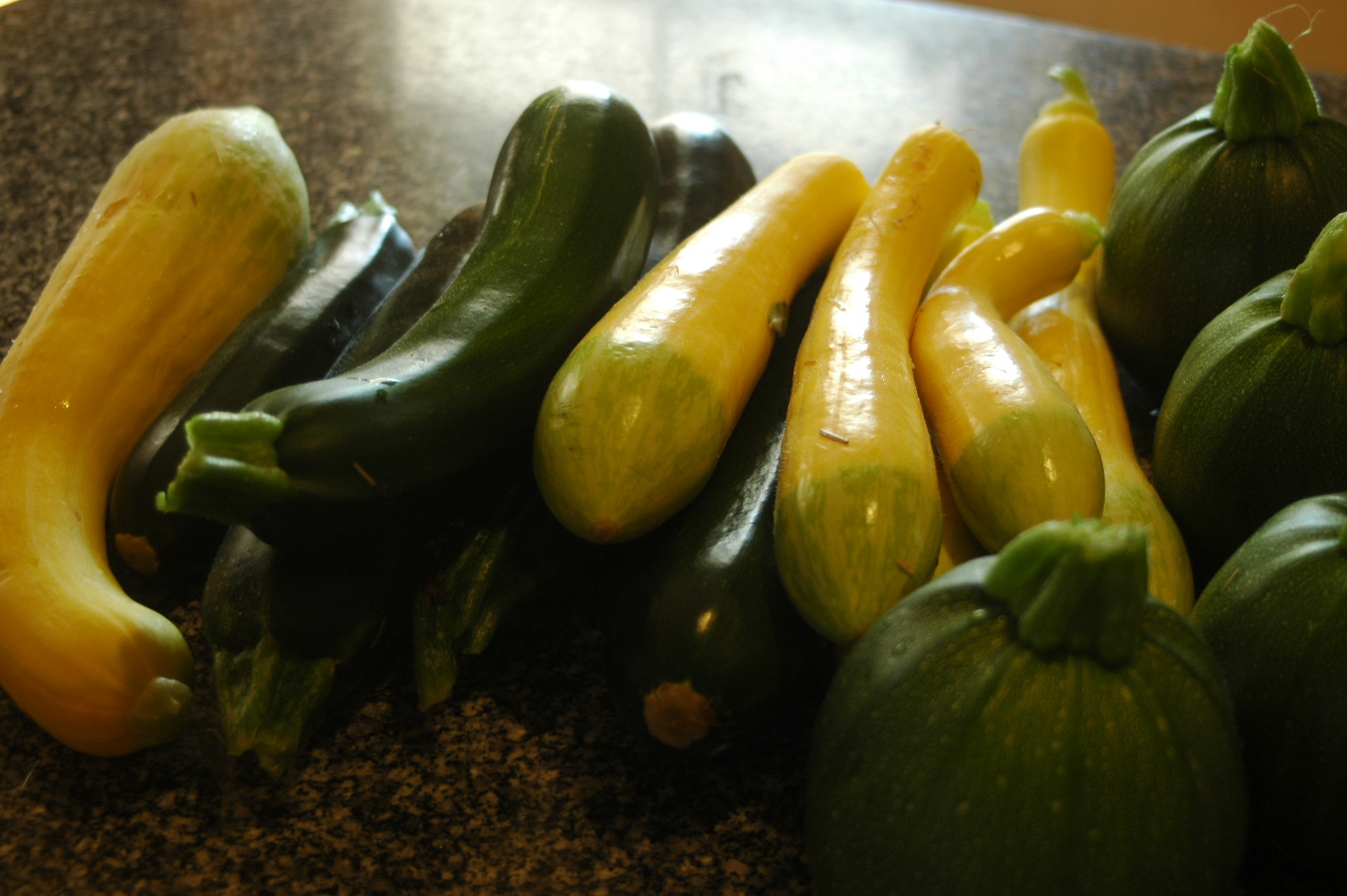
Also, I happen to love zucchini and its yellow cousins. Even now, when the faucets are full-on open, I love them. How can you not love a plant that is so supremely organized and efficient that it can crank out these handsome items 


by the bucketload when all the plants around them are gasping from drought, bolting from heat, withering in the sun? Even when a basket-busting, counter-obscuring, headache-threatening metric buttload of zucchini comes thundering into the house, my ardor remains strong. 

There are a lot of reasons for this ardor, and one them is Julie, who is the undisputed champion of so many areas of the menu that is has become pointless to catalog her numerous titles (Queen of the Bean, Empress of Elixirs, Chile Tsarina). Some broader title needs to be established for her. In one of her characteristically casual moments of generosity, she emailed me about this zucchini soup she had been whipping together. I lacked a few of the things required to reconstruct it exactly, but because I received the email while bushwhacking through a bushel of squash, I punted. 

That was two summers ago, and I've never looked back. With this handy method, it is possible to render a Code Blue Zucchini Situation like this:


into a call for quiet gloating like this:


Magical!  Here is Julie's Zucchini Soup v. 2.0, wherein you, our hero, capitalize on zucchini's confounding ability to sweat large amounts of liquid in the presence of salt, and produce for yourself a substance which can magically transform from summer refresher to winter restorative at the flick of your wrist.  Chill this down right now, and serve it as is--or with a squeeze of lemon on top and maybe a splash of olive or chile oil or a swirl of pesto or a sprinkling of fresh herbs, maybe some buttermilk or this magical yogurt --and you will swagger around feeling pretty spiffy at the end of a hot day.  Maybe you can't bear the idea of another zucchini right now.  Whatever your feelings regarding the zucchini in July, I can attest you will approach it with a twinkle in your eye come February. In the produce doldrums, a warm bowl of this with a swirl of heavy cream and some curry powder is a welcome sight on the placemat.  I freeze as much of this stuff as I can jam into the Kenmore.  Thank you, Julie.

Measurements are profoundly approximate here.  It's more of a method than a recipe.  If your zucchini payload is mostly on the young side (admittedly preferable), no special treatment is required.  If they are a little more aged than that (still well worth using), use your judgement regarding peeling tough outer bits and discarding cottony centers, and try to work a few of the juvenile specimens in with them to ensure that lovely color.


zucchini soup

For every seven or eight zucchini, one medium onion, a decent splash of olive oil and about a quarter cup of white wine (Mirin, or Japanese rice wine, makes a nice alternative), plus salt and pepper and about a teaspoon of lemon zest, very finely grated.

Dice the onion, and heat the olive oil in a large soup pot.  Saute the onion over low heat with about a teaspoon of salt, stirring as necessary, until the onion is soft and not at all brown, about five minutes.

Meanwhile,  hack the squash up by no special method into chunks of 1-2".


Add the squash to the onion along with the wine and lemon and a few twists of pepper, and give it all a good stir.  Turn the heat up, and when the zucchini pieces are nicely coated, add about a cup of water (or broth, if you feel you must, but water is fine).  Bring this to a nice boil, lower the heat to a simmer, and cover the pot.

Cook, stirring every couple minutes to ensure even heating, until the squash has given up a nice amount of liquid and is tender but still bright, like so:


Now attack the pot with your stick blender, and render yourself a nicely even purée.  Fish around determinedly for lurking chunks, and show them no mercy.  A gloriously green and supremely smooth soup is your goal.  You can do this, of course, in batches in a regular blender but take care to recall that hot liquids expand and caution must be exercised.  I tend to burn my eyeballs and make a hell of a mess when I use the regular blender for hot soup.  

Cool and deploy. 

Friday, April 13, 2012

fish stories

I heard two things on the radio this morning that stuck to the lint trap in my head.

First, a team of scientists has established credible data that weekly consumption of fish significantly reduces the risk of developing Alzheimer's Disease later in your life, so they counsel us to fire up the broiler and get busy with the filets.

Second, stocks of jack mackerel in the South Pacific have been depleted by approximately 60 percent in the last six years, ironically the same exact six years since the three nations that fish the area most heavily (Chile, Australia and New Zealand) established a coalition to protect the fishery. Depletion is due to, well, greed mainly, and due to the huge proportion of juvenile fish in the catch, caught before they can breed and repopulate the stock. In 2008, independent review showed that more than 60% of the mackerel caught were below the agreed-upon minimum size limit, and last year that percentage had increased to more than 90%. Increased! Awesome coalition, dudes. Rock on. Sicken yourself further here, if I have not ruined your day already.

OK, let me keep trying. Who is eating all that mackerel? Salmon. Farmed salmon. Most of the mackerel are ground up to produce fish meal for salmon farms, where the conversion ratio is approximately 4 pounds of mackerel to your dinner for 4 (or one pound of salmon.) 80 to 90% of the salmon consumed in the US is farmed, by the way, with disastrous results for natural populations.

I'm as attentive to resources like Good Catch and the Monterey Bay Aquarium list of "greener" fish choices as the next self-flagellating, confused, hungry, do-good wannabe. But the lists begin to lose some of their powers of persuasion for me when I hear a back story like this one. It's all relative, and the conditions of that relativity are unknown to most of us, who see "organic eco-farmed salmon" and think that sounds like it might be an OK choice. What is it that is supposed to matter, now that I think of it here in the store with the line forming behind me? Organic means no chemicals, so that's good because I think regular salmon is colored with synthetic dye and pumped up on pharmaceuticals, or was it farmed is better, because then natural stocks are not overfished, or was it that wild-caught that was the way to go, because there's something about farming that is bad? What did I read, again? (For reference, just file away that you can freely ignore the "organic" label in the fish market; there are no standards for organic certification for fish, it is not regulated at all and is entirely at the whim of the producer to slap the label on).

The thing of it is, these are tough times for the mackerel, and the native apple, and the honeybee, and for any human trying to source their food responsibly. What is good for our geriatric brains is hell on the planet; increasingly, it seems that what's good for the planet is for all of us to lie down very quietly and try not to work up an appetite or drive anywhere.

It's tempting to respond by throwing the hands upward. Too much to attend to! Gotta eat!

In times of dietary confusion, I always roll back to two things: something I can source near me, and vegetables. Thank goodness it's spring, and those twain are getting ready to meet again. Something from the dirt close by always soothes.

No recipe today. Just some sparks, to light the fire of the first foods of spring. What's ready where you are? (Forgive me but I don't really want to hear your answer on this one if you live west of, like, Pennsylvania, OK? You folks just answer in your heads.)

Here's your sparks:

These
raw and sprightly asparagus, or these cooked and spicy ones, or this soup.

Make a radish salad, with slivered radishes and plenty of lemon and parsley and good coarse salt and pepper, or Indian-style, grated, with fresh grated ginger, lime juice and a spike of chile. What about a radish sandwich, using plenty of good butter and salt and dark bread? Or make radish hash browns! The rest of the world seems to be doing it.

Pickle a ramp
.

Have good eggs? Make ricotta (there she goes again!) and a frittata thereafter, maybe using not only the mint called for, but the first chives and lovage and greens that are poking up.

Make soup from weeds (and that whey you have in the fridge now!).

Have a great weekend. Monday is cookie day! (No fish in the cookies.)